
Digital scan
We accept scans from most major systems including 3Shape and Medit, or scan in-house directly with no impression material.
Twenty-seven years of laboratory precision in Dubai. We design, mill and hand-layer under one roof — for our own patients, and, by the laboratory’s own published count, for more than 800 doctors and clinics in Dubai.
This page is written for patients of the clinic. Creative Art Dental Lab also works with outside clinics — for case submission, scan files and turnaround, see the lab for dentists, contact the laboratory through its own website, cad-l.com, or call the laboratory line listed below.
A patient looking for treatment? Book a consultation at the clinic+971 4 342 4444

Basem Tobaji is CEO of Creative Art Group, a dental technician licensed by the Dubai Health Authority, and a smile design expert with about 30 years in the dental field. He is a co-founder of DIA Academy. He is not a dentist: he does not diagnose, treat patients or place implants.
How the businesses connect. Creative Art Group includes Creative Art Dental Lab and Creative Arts Aesthetic & Dental Center. They are separate businesses in the same building: the clinic's dentists examine, plan and treat; the laboratory designs and makes the ceramic work they prescribe — veneers, crowns, bridges and implant restorations — for the clinic's patients and, by the lab's own published count, for 800+ doctors and clinics in Dubai.
His role in the work you see. He leads the group the laboratory belongs to and brings a technician's view to smile design: tooth proportion, shade, translucency and surface texture. The final plan for each patient is always the treating dentist's.
Five stages, all in the same building. No courier and no middleman.
We accept scans from most major systems including 3Shape and Medit, or scan in-house directly with no impression material.
The technician designs the restoration digitally — margins, contact points and occlusal anatomy — verifying marginal fit before anything is made.
Milled from a solid ceramic block, with 3D printing for models and surgical guides.
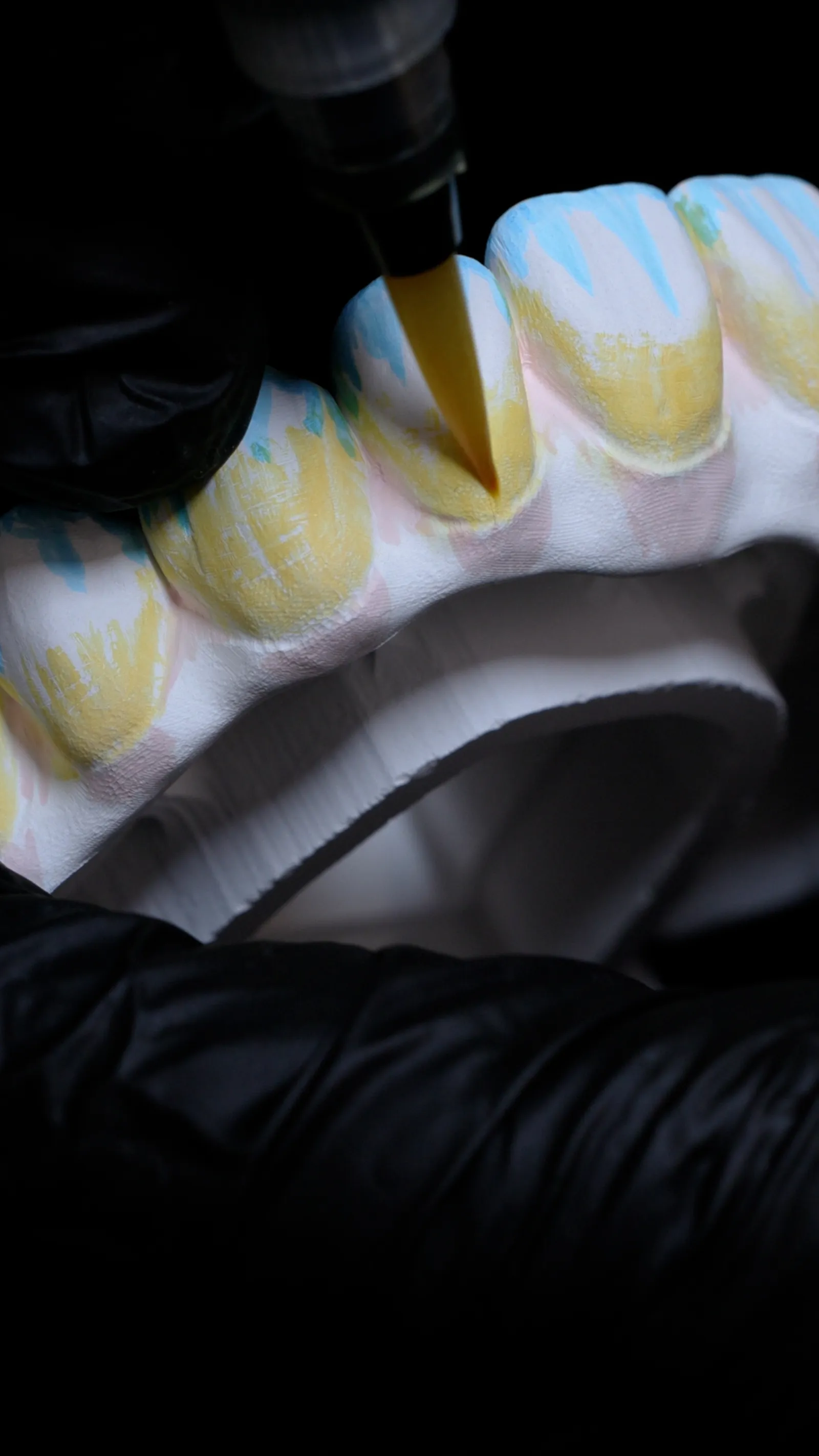
Where machines stop and craft begins — colour depth, translucency and surface texture added by hand so the result reads as natural.
Fit, shade and occlusion verified before delivery, with same-day adjustments where needed.
Three points in the same process: the framework that carries a full-arch case, the units built on a sectioned model, and the finished arch assessed in occlusion.


Photographed on working models in our laboratory. Materials, shades and design differ from case to case and are decided with the treating dentist.
Material choice is a clinical decision based on where the restoration sits, the forces it takes and how visible it is.
Very high strength for posterior teeth, bridges and implant work, with layered options for aesthetic cases.
Excellent translucency with good strength — the workhorse for anterior crowns and veneers.
The closest match to natural enamel for thin, highly aesthetic veneers. Demands expert handling.
We accept digital scan files from most major systems — including 3Shape and Medit.
Each page explains the restoration, the material choices and how the lab and the dentist work on it together.

Feldspathic and E.max veneers, designed from an approved smile mock-up.

Lithium disilicate: strength with translucency at the edge.

Hand-layered porcelain for thin, highly aesthetic cases.

A full upper (and often lower) smile designed as one arch.
Zirconia and E.max crowns, chosen tooth by tooth.

Monolithic or layered zirconia for strength.

Bridges designed as one piece against the bite.

Implant crowns and full-arch prostheses, with pink ceramic where gum is lost.

Many restorations planned as one bite.

Scan, design, milling, 3D printing and hand finishing.

3Shape and Medit scans, prescriptions, shade and turnaround.

Real patient cases from the clinic.
Shade alone does not make a restoration convincing. Surface texture, the gradient from neck to edge, translucency at the biting edge and the way a unit emerges from the gum line do.


Real footage from our own laboratory — scanning, milling, 3D printing and hand staining.
A full-arch case has a structural part and a visible part. The framework fixes to the implants; the prosthesis above it carries the teeth and, where gum tissue has been lost, the gingival portion too.


How implant crowns and full-arch prostheses are designed, what dentists send and how the lab and the implant dentist divide the work: implant restorations at Creative Art Dental Lab.
Photographs of finished work on the models it was built on, taken in our own laboratory. These are laboratory cases, not patient before-and-after photographs, and no individual clinician is identified.


Photographed on working models in our laboratory. Materials, shades and design differ from case to case and are decided with the treating dentist.
You book with the clinic, not the laboratory. A dentist diagnoses and plans; the lab executes the technical part of that plan. What being in one building buys you is that the technician can see your teeth under the same light as the clinician, instead of working from photographs.
You deal with the laboratory directly. It has its own line, its own inbox and its own opening days, separate from the clinic. We accept digital scans from 3Shape, Medit and other systems, and coordinate collection and delivery within Dubai. How to send a case →
+971 56 979 2929[email protected]
Creative Art Dental Lab — Monday to Saturday 10:00–20:00, closed Sunday.
For clinics and doctors: we accept digital scans and coordinate collection and delivery. For patients: ask which restoration suits your case.
Short, factual answers. Each links to a page with more detail.
It designs and makes the restorations a dentist prescribes — crowns, bridges, veneers and the teeth that sit on implants — from the dentist's scan, records and shade information. The dentist diagnoses, prepares and fits; the laboratory does not treat patients.
To turn the prescription into a restoration: design it, decide how the ceramic is built up, layer, stain and glaze it, then check fit, contacts and bite on a model before it returns to the clinic.
The smile is designed and approved as a mock-up, the dentist prepares and scans the teeth, and the technician designs each veneer, makes it in feldspathic porcelain or E.max and finishes colour and texture by hand. Step by step.
From the scan the lab prints a model, designs the crown on screen, mills it from zirconia or E.max, then stains, glazes or layers it and checks margins and bite. Typical laboratory time here is 3–5 working days.
A lithium disilicate glass-ceramic with good strength and high translucency, often used for veneers, front crowns and premolars and bonded in place. It is not the first choice for the heaviest back-tooth loads.
A very strong tooth-coloured ceramic (zirconium dioxide). Monolithic zirconia suits molars, bridges and implant work; layered zirconia adds porcelain for appearance. It is less translucent than glass-ceramics. E.max vs zirconia.
CAD is designing a restoration on screen from a 3D scan; CAM is making it by milling ceramic or 3D printing. Here every milled piece is still finished by a technician. Digital workflow.
The dentist sends scan files (3Shape, Medit and most major systems), a prescription and shade information; the lab designs, queries anything unclear, makes and checks the work and returns it for try-in. For dentists.
The dentist and patient set the goals; the smile is designed digitally and shown as a mock-up the patient approves before any irreversible step. The laboratory translates that approved design into ceramic.
The dentist places the implant and scans it with a scan body; the lab designs the crown or full-arch prosthesis that connects to it, shaping emergence and bite, and makes it in zirconia or ceramic. Implant restorations.
Building colour, translucency and surface texture so a restoration matches the neighbouring teeth. For clinic patients the technician can see the teeth under the same light as the dentist. Shade matching guide.
Yes, and it is a substantial part of what the laboratory does. On its own site, cad-l.com, the lab states it serves more than 800 doctors and clinics in Dubai. We accept digital scans from most major systems including 3Shape and Medit, and can coordinate collection and delivery within Dubai. The laboratory is reached directly on +971 56 979 2929 or [email protected] — a different line from the clinic’s patient booking number.
Most restorations complete within three to five working days depending on complexity and design. Urgent cases are discussed against current schedule.
We offer custom shade matching. For our own patients the technician sees the teeth directly under the same lighting as the clinician; for partner clinics we work from reference photographs with a shade tab.
Yes. The lab is in the same building as the clinic at 614 Jumeirah St, Umm Suqeim, Jumeirah 3, and you are welcome to see where your case is made.
No. Dentists at the clinic examine, plan and treat; Creative Art Dental Lab designs and makes the restorations they prescribe. For treatment, book a consultation with the clinic on +971 4 342 4444.
Yes. The lab makes implant crowns and implant-supported full-arch prostheses, with pink gingival ceramic where gum tissue has been lost. Implants are planned and placed by the dentist, not the laboratory. See implant restorations.
Basem Tobaji is CEO of Creative Art Group, a DHA-licensed dental technician and smile design expert with about 30 years in the dental field, and a co-founder of DIA Academy. He is not a dentist. Profile.