Gum contouring
Reshaping excess gum to even out the gum line or reduce a gummy smile, often alongside veneers or crowns. See laser gum contouring.
A dental laser is a precise tool for gum and soft-tissue work. It is not a replacement for drills, cleaning or surgery, and this page sets out plainly where we use it, where we do not, and why.
Tell us what you would like treated; the dentist will explain whether a laser is the right tool for it.
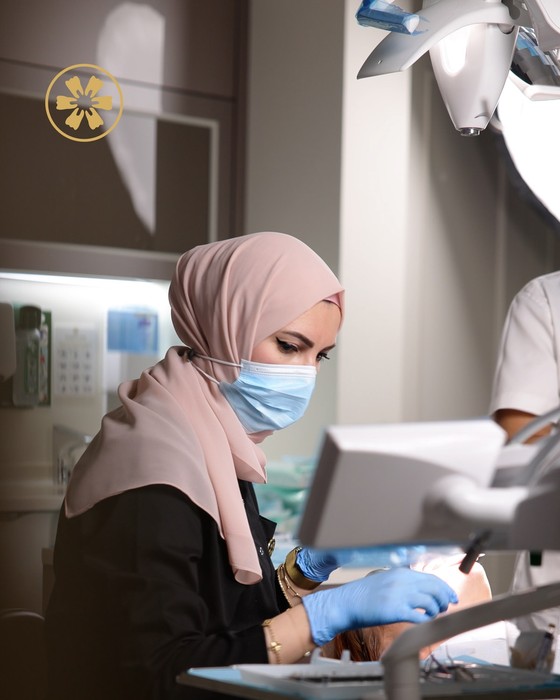
At Creative Arts in Dubai, the dental laser is used for soft tissue: reshaping gum with laser gum contouring, removing overgrown gum (gingivectomy) and other small soft-tissue procedures chosen by the dentist. It cuts precisely and usually with little bleeding. It does not replace drills for fillings, surgical instruments for implants, or cleaning for gum disease. Laser-activated whitening uses a light to activate a gel, which is a different process.
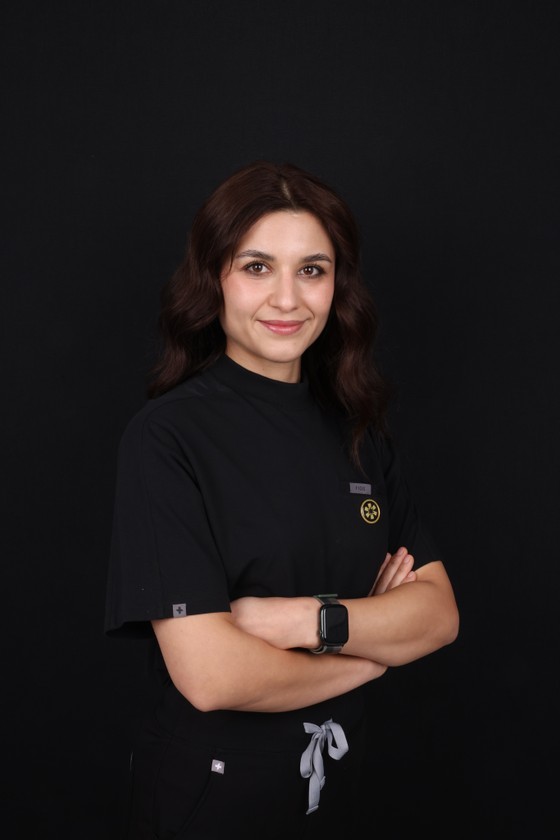
Who treats you here Dr. Duaa Ameen General Dentist · Dr. Taban Ameen Dentist
Every dentist’s licence can be checked on the DHA Sheryan medical directory.
Our dental laser is used on gum and other soft tissue. Each use is decided after an examination, not because a patient asks for 'laser treatment'.
Reshaping excess gum to even out the gum line or reduce a gummy smile, often alongside veneers or crowns. See laser gum contouring.
Removing gum that has grown over the teeth, for example around braces or because of some medicines, once inflammation has been treated.
Exposing a tooth edge for a filling or impression, or trimming gum around a restoration, where a precise cut with little bleeding helps.
In selected gum cases the laser may be used as an addition to cleaning, never instead of it. Laser gum treatment explains when.
Patients often search for 'laser' versions of every treatment. Here is what each phrase usually means and what Creative Arts does.
| You may have read about | What it usually means | At Creative Arts |
|---|---|---|
| Laser fillings | Some laser types can remove decay in certain cases; most fillings worldwide are still prepared with drills | Fillings are prepared with conventional instruments under local anaesthetic; we do not offer laser fillings |
| Laser teeth cleaning | A laser used alongside scaling for gum pockets, or a marketing name for ordinary cleaning | Cleaning is done with Guided Biofilm Therapy and hand or ultrasonic instruments, not a laser |
| Laser implants | Usually a laser used on the gum at some stage; the implant site in bone is prepared with drills | Implants are placed with surgical drills, often 3D-guided; read laser dental implants |
| Laser root canal | A laser used to help disinfect the canals in some techniques | Root canals are cleaned with instruments and irrigating solutions, using a dental microscope where needed; we do not offer laser root canals |
| Laser teeth whitening | A light or laser used to activate a whitening gel | Offered as in-clinic laser teeth whitening; it is a different process from soft-tissue laser work |
| Laser gum contouring | Removing and reshaping excess gum with a soft-tissue laser | Offered after assessment of the gum and bone levels |
If a treatment is advertised as 'laser', ask which part of it uses the laser, and what the alternative would be.
For soft tissue, a laser has genuine practical advantages. It cuts and seals small blood vessels at the same time, so there is usually little bleeding, it allows fine reshaping of the gum line, and many small procedures need no stitches. That is why it suits gum contouring and gingivectomy.
For other jobs the picture is different. A laser does not replace removing plaque and tartar, which is what actually treats gum disease. The American Academy of Periodontology's best-evidence consensus on lasers found that, when laser treatment is used in addition to mechanical periodontal treatment, outcomes are similar or slightly better, that there is no added benefit over traditional periodontal surgery, and that the evidence is insufficient for definitive conclusions. In other words, a laser can be a helpful extra in selected cases, not a shortcut.
The same applies to hard tissue. Drills and surgical instruments remain the standard tools for preparing teeth and bone. The choice of tool matters much less than an accurate diagnosis and a well-planned treatment.
A laser is chosen for the problem, not the other way round. These are typical situations.
Most soft-tissue laser procedures are short. Planning takes longer than the procedure itself.
The gums are measured, and X-rays are taken if the bone level or a tooth needs checking, so the cause of the problem is clear.
Visit 1You receive a written plan explaining why a laser is suggested, what else could be done and what result is realistic.
Visit 1Any gum inflammation is treated first. On the day, local anaesthetic is given and everyone in the room wears protective glasses.
Treatment dayThe dentist reshapes or removes the soft tissue in small, controlled steps.
Usually shortYou receive written aftercare. Gums are usually tender for a few days, and a review checks healing.
Follow-upLaser procedures on the gum are usually done under local anaesthetic, just like other gum procedures. Afterwards the area is often tender for a few days, and discomfort is usually managed with over-the-counter pain relief taken as directed on the label. Because the laser seals small vessels as it works, bleeding is usually minimal, and many patients find the recovery straightforward. Laser treatment is not 'drill-free dentistry', and no procedure should be promised to be free of discomfort.
Dental lasers are safe when used correctly. The main precaution is eye protection: the laser beam can damage the eyes, so you and the dental team wear protective glasses throughout. The dentist chooses the settings for each tissue and procedure.
Dr. Taban Ameen focuses on laser and cosmetic dentistry and gum treatment, and Dr. Duaa Ameen on gum care, conservative cosmetic treatment and hygiene. Together they assess whether a laser suits your gums and carry out soft-tissue laser procedures.
There is no single 'laser price'. The cost depends on what is being treated and what else is needed.
Clinical statements on this page are consistent with these independent sources. They describe averages from studies, not a promise for any one patient.
No dental procedure should be promised as free of discomfort. Laser procedures on the gum are usually done under local anaesthetic, and the area is often tender for a few days afterwards. Because the laser seals small blood vessels, bleeding is usually minimal, and discomfort is usually managed with over-the-counter pain relief taken as directed.
No. At Creative Arts, cavities are prepared with conventional instruments under local anaesthetic and repaired with tooth-coloured fillings. Some laser types can remove decay in certain cases, but that is not a service we offer. The dental laser here is used for gum and soft-tissue work.
Cleaning removes plaque and tartar, which a laser does not replace. At Creative Arts teeth are cleaned with Guided Biofilm Therapy and conventional instruments. In some gum disease cases a laser may be added to deep cleaning, and evidence suggests outcomes are similar or slightly better when it is used that way.
Not quite. In laser or light-activated whitening, a light is used to activate a whitening gel on the teeth. Soft-tissue laser dentistry uses a dental laser to cut and reshape gum. Both are available at Creative Arts, but they are different treatments with different aims and aftercare.
Sometimes. If extra gum covers the teeth and the bone level allows it, laser gum contouring can reshape the gum line. If a gummy smile is caused by the jaw, the lip or tooth position, other treatments may be needed. The gums and X-rays are assessed first to find out which applies.
It depends on the procedure. After small soft-tissue procedures, gums are usually tender for a few days and settle over the following weeks. More extensive reshaping takes longer to mature. You receive written aftercare, and a review visit checks healing before any further treatment such as veneers or crowns.
Soft-tissue lasers are used for children in some dental settings, with the same eye protection as for adults. Whether a laser procedure is appropriate for a child depends on the problem and the child's age and cooperation. At Creative Arts, the dentist explains the options after examining your child.
Creative Arts has a single clinic on Jumeira Street (Jumeirah Beach Road). Ask about parking when you book.
Our clinic in Jumeirah Open in Google Maps · Rated 4.8 on Google from 238 patient reviews (October 2026) — read them
Tell us what you would like to change. The clinic replies within working hours with an appointment time.
Or call us +971 4 342 4444Or message us on WhatsApp
A consultation ends with a diagnosis and a written, itemised plan — not a sales pitch. Book online, message us on WhatsApp, or call the clinic.