
Single Tooth Veneer in Dubai
A single veneer has nowhere to hide. It sits beside natural teeth that set the standard for colour, translucency and texture, which makes it the most exacting shade job in cosmetic dentistry.
- Ceramist sees your teeth in person
- Alternatives discussed first
- Tried in before bonding
Bring old photos of the tooth before it changed if you have them — they help with shape and shade.

Can you get a veneer on just one tooth?
Yes. A single veneer can correct one chipped, discoloured, misshapen or slightly rotated front tooth, but it must match the natural teeth beside it in shade, translucency and surface texture, which makes it one of the most demanding veneer cases. At Creative Arts in Dubai the ceramist works in the same building, sees the neighbouring teeth in person, and the veneer is tried in before it is bonded.

Why is one veneer harder to match than a full set?
With eight or ten veneers, the dentist and ceramist set the colour of the whole smile, and the veneers only need to match each other. With one veneer the target is fixed: your own natural tooth, right beside it.
- Brightness: the eye notices a tooth that is too bright or too grey before a wrong hue.
- Translucency: how much light passes through the biting edge.
- Texture and lustre: fine ridges and shine that reflect light like the neighbour.
- The colour underneath: a darker tooth shows through thin ceramic.
- Shape: a front tooth should mirror its partner across the midline.
A veneer can match under clinic light and look different in daylight or a camera flash, so shade is checked in more than one light. The shade matching guide explains the method.
One tooth, several possible answers
A veneer is not automatically the answer for one tooth that bothers you. These are the options, from least to most invasive.
| Usually suits | Keep in mind | |
|---|---|---|
| Whitening | Teeth that are all slightly yellow, with no single tooth very different | Lightens natural enamel only; a tooth darkened after an injury often responds poorly |
| Composite bonding | A small chip, a narrow gap or a slightly short edge | One visit and repairable, but resin stains (composite bonding) |
| Composite veneer | Changing the whole face of the tooth while keeping enamel | Little or no drilling; usually refreshed after a few years (composite veneers) |
| Ceramic veneer | A chipped, discoloured or misshapen tooth with healthy enamel | Some enamel removed; the hardest shade match, but colour-stable |
| Crown | A root-treated, heavily filled or broken tooth | More tooth removed, but protects a weakened tooth (dental crowns) |
| Orthodontics | A tooth that is out of line rather than the wrong shape | Takes months; no enamel removed (Invisalign) |
The right answer depends on why the tooth looks different, so an examination comes first.
How a single veneer is matched, visit by visit
The stages match any veneer, with more time spent on shade.
Find out why this tooth differs
Examination, X-ray and, for a dark tooth, a nerve check. A tooth that darkened after a knock needs that answered first — see one dark tooth.
Visit 1Shade before the teeth dry
Teeth look lighter as they dry during treatment, so shade is recorded at the start, with photographs of shade tabs beside the neighbour.
Start of visitThe ceramist sees your teeth
The ceramist from the laboratory in the same building can see the neighbouring teeth in person, under the same light as your dentist.
Shade visitConservative preparation
Enamel is reduced only where the design needs space. The colour of the prepared tooth is recorded for the ceramist, and a temporary is fitted.
PreparationTry-in with test paste
The veneer is tried with a removable paste that previews the cement colour, then checked in daylight. If it is not right, it goes back to the laboratory; some adjustments can be made the same day.
Try-inBonding & review
Once you and your dentist approve it, the veneer is bonded and the bite checked. A review confirms the match after the tooth rehydrates.
Fitting + review
A single veneer: the key facts
- Suits
- One chipped, discoloured, worn or misshapen front tooth with healthy gums
- Material
- Usually E.max or hand-layered feldspathic porcelain, chosen at examination
- Shade
- Recorded at the start of the visit and checked in person by the ceramist
- Typical visits
- Consultation, preparation, try-in, bonding and review; sometimes an extra shade visit
- Anaesthesia
- Local anaesthetic for preparation
- Made by
- Creative Art Dental Lab, in the same building as the clinic
- Where
- 614 Jumeira St, Jumeirah 3, Dubai
When does one veneer become two?
The two upper front teeth are read as a pair. If one is veneered and the other has an old composite edge, a different length or a worn corner, the new veneer can be well made and the pair still look mismatched. Treating both teeth then often looks more symmetrical than chasing a match to an imperfect neighbour.
- The neighbour is not the colour you want. Whiten first, let the shade settle for about two weeks, then match the veneer.
- The gum line is uneven. A veneer cannot lower a gum margin that sits higher on one tooth; gum contouring with veneers may be part of the plan.
- The partner tooth has a different shape. Mirroring it may mean a small change to that tooth too.
None of this should be assumed. A mock-up of one tooth, and of two, shows the difference before you decide. The main veneers page explains how larger cases are planned.

Why a laboratory next door matters for one veneer
A single veneer is often refined more than once: more translucency at the edge, a warmer tone near the gum, a different surface texture. Creative Art Dental Lab is in the same building, so the ceramist looks at your teeth rather than a photograph, and a veneer that needs adjusting is not shipped back and forth.
- 1Consultation & records — examination, photographs and the radiographs your case needs
- 2Digital scan — an intraoral scan replaces impression trays for most cases
- 3Design — the restoration or smile is designed digitally and reviewed with you
- 4Lab fabrication — milled from ceramic, then hand-finished for shade and texture
- 5Try-in — shade, shape and fit checked in your mouth, adjusted in-house if needed
- 6Placement & review — bonded or cemented, bite balanced, reviewed afterwards
Who makes your veneer?
Your dentist examines the tooth, plans the treatment and fits the veneer. The ceramic is made at Creative Art Dental Lab, part of Creative Art Group, whose CEO, Basem Tobaji, is a Celebrity Smile Designer with about 30 years in the dental field. He does not examine or treat patients.
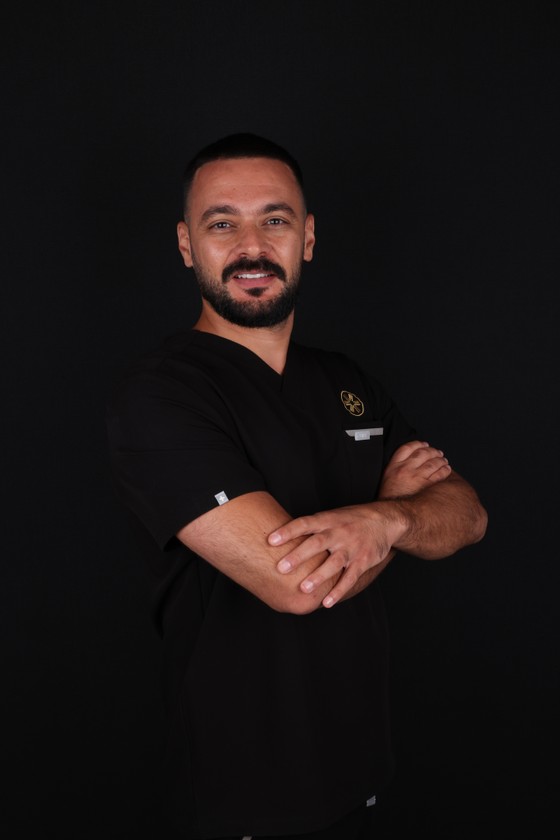
Dentists who plan and fit single veneers here
Single-tooth cases are planned by the dentist who fits the veneer, with the ceramist involved from the shade stage.



Frequently asked questions
Will a single veneer match my natural teeth?
It can match closely, but it takes more care than a full set. The ceramist copies the brightness, translucency and texture of the tooth beside it and allows for the colour of the tooth underneath. A try-in before bonding lets you check the match in daylight, and it is adjusted before it is fixed if needed.
Can I get one veneer on a dark, root-treated tooth?
Sometimes. The root canal is checked on an X-ray first, along with how much tooth remains. A dark tooth needs a veneer that can hide the colour underneath, which may mean a more opaque ceramic or a little more thickness. If large fillings have weakened it, a crown usually protects it better.
Should I whiten my teeth before getting one veneer?
If you want your natural teeth lighter, yes. Ceramic does not change colour with whitening, so the veneer is matched to whatever shade your teeth are when it is made. Whitening first, then waiting about two weeks for the colour to settle, means the veneer is matched to your new shade.
What if the shade of my single veneer is not right at try-in?
It is not bonded. The veneer goes back to the laboratory in the same building for the ceramist to adjust its colour, translucency or surface. Some adjustments can be made the same day; others need another appointment. A second try-in for one front tooth is normal.
Can a single veneer fix a chipped front tooth?
Yes, if the chip is too large for bonding to look natural or last well and the tooth is otherwise healthy. Small chips are usually repaired with composite bonding, and large fractures often need a crown. Veneers for chipped teeth explains where each option fits.
One veneer or a crown for a single front tooth?
A veneer keeps more of your tooth and suits a structurally sound tooth. A crown covers the whole tooth and is chosen when it is broken, heavily filled or weakened. Both can be matched to the neighbouring teeth; the deciding factor is how much healthy tooth is left.
Will one veneer still match my teeth in ten years?
Natural teeth slowly darken and stain with age while ceramic keeps its colour, so a small difference can appear over the years. Regular cleaning limits staining, and gentle whitening can narrow the gap. If the difference becomes noticeable, the veneer can be remade and re-matched.
Related treatments
Request a consultation
Tell us what you would like to change. The clinic replies within working hours with an appointment time.
- Address614 Jumeira St, Jumeirah 3, Umm Suqeim 1, Dubai
- Opening hoursClinic open daily, 10:00–20:00
- Phone+971 4 342 4444 · WhatsApp +971 56 677 7537
Book Your Consultation
Or call us +971 4 342 4444Or message us on WhatsApp
Talk to a dentist about your case
A consultation ends with a diagnosis and a written, itemised plan — not a sales pitch. Book online, message us on WhatsApp, or call the clinic.