
Root canal or implant: how the decision is actually made
An honest comparison of saving a tooth with root canal treatment versus extracting and placing an implant — success rates, cost over time, and the factors that actually decide.
Last medically reviewed: 12 October 2026

Smiles made at Creative Arts
Designed in the clinic and made by hand in Creative Art Dental Lab, in the same building in Jumeirah, Dubai.
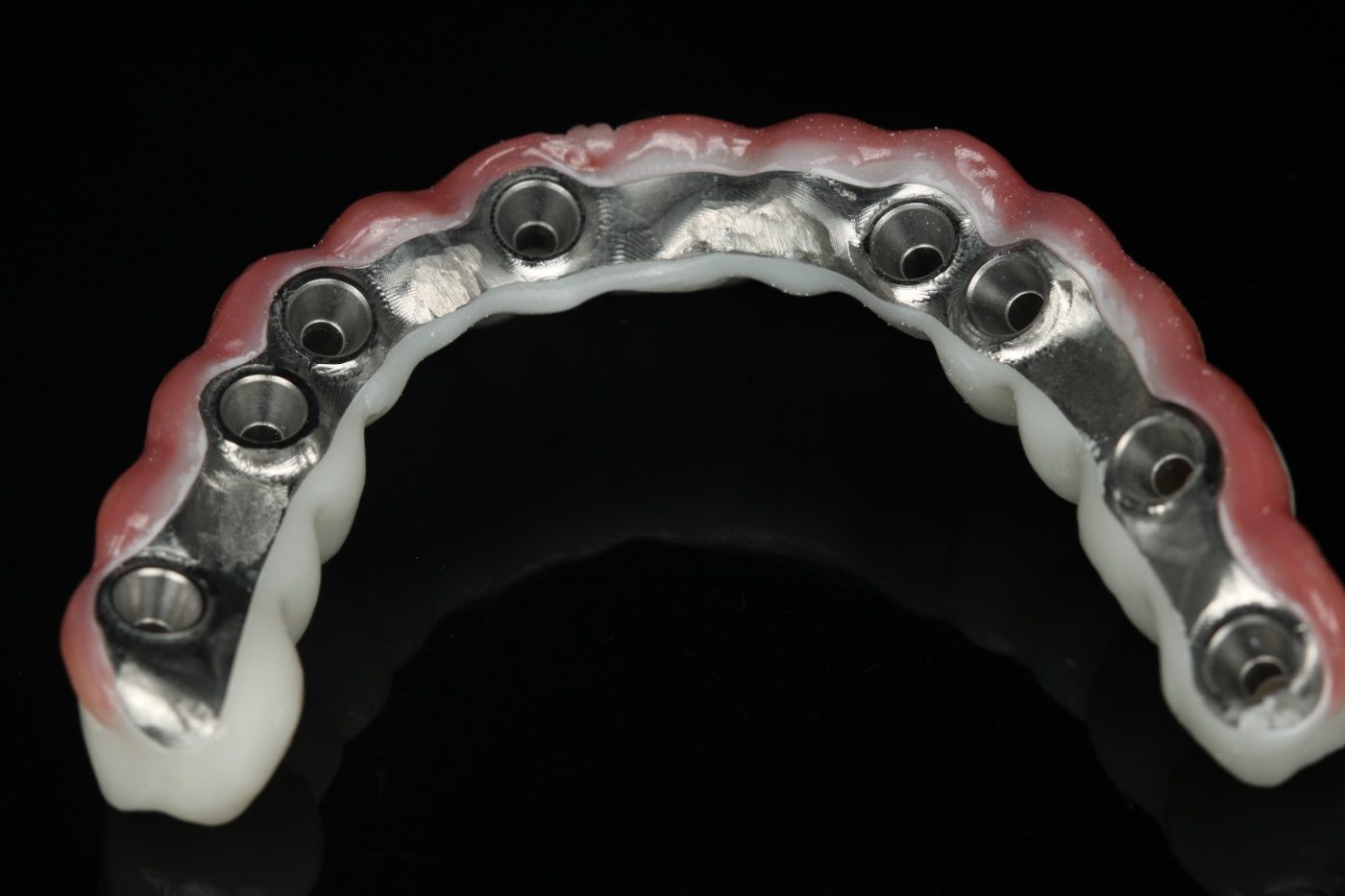


The price depends on your case and is written in your treatment plan after the examination. See: implants at our Jumeirah clinic.
This is one of the most common decisions in dentistry, and it is frequently presented as a matter of opinion. It is not. In most cases the tooth itself decides — you just need the right information to see it.
The default position: save the tooth
A natural tooth has something no implant reproduces: the periodontal ligament.
This thin layer of fibres suspending the root in bone provides shock absorption, and it contains proprioceptive nerve endings that let you sense bite pressure with remarkable precision. It is why you feel a grain of sand in food, and why a natural tooth adapts to load in a way an implant cannot.
An implant is fused directly to bone. Functionally excellent, but the feedback is gone.
So the starting position in modern dentistry is: if the tooth can be predictably restored, save it. An implant is the best replacement available — but replacement is still second best to keeping what you have.
Questions about your own teeth? Send a photo on WhatsApp and the clinic will tell you what an examination would check.
WhatsApp usWhen a root canal is the right answer
Root canal treatment is indicated and predictable when:
- Sufficient tooth structure remains to support a crown — this is the single biggest factor
- Bone support is adequate with no severe periodontal loss
- There is no vertical root fracture
- The tooth is strategically useful in your bite
- The canal anatomy is treatable, which a 3D scan confirms
Under those conditions, a properly treated and crowned tooth can last decades. Our endodontics page covers the protocol, including why rubber dam isolation matters so much to success.
When an implant is genuinely the better outcome
We would rather say this at diagnosis than after you have paid for treatment that will not hold:
- Vertical root fracture — this cannot be repaired. A tooth that is split will not hold, regardless of how well the canal is treated.
- Insufficient remaining structure — if there is not enough tooth above the bone to grip a crown, the restoration has nothing to hold onto.
- Severe periodontal bone loss — a tooth that is already mobile from bone loss will not be saved by treating the nerve. That is treating the wrong disease.
- Failed retreatment where surgery is not viable.
- A tooth that would need extensive additional work — crown lengthening plus a post plus a crown — with a marginal prognosis at the end.
In these cases, heroically retaining the tooth costs more, takes longer, and often ends in extraction anyway — with less bone remaining for the implant, which may then require grafting that would not have been needed.
The comparison, honestly
| Root canal + crown | Extraction + implant | |
|---|---|---|
| Keeps natural tooth | Yes | No |
| Shock absorption | Yes (ligament intact) | No |
| Pressure sensation | Fine | Reduced |
| Adjacent teeth | Untouched | Untouched |
| Treatment time | Weeks | Months (integration) |
| Upfront cost | Lower | Higher |
| Can decay later | Yes, at the margin | No, but peri-implantitis can occur |
| Main failure mode | Fracture, reinfection | Peri-implantitis, early failure |
Note that both have failure modes. Neither is permanent in the sense of never needing attention.
The factor most people underestimate
The crown after the root canal is not optional.
A root-treated tooth has lost its blood supply and structure from both decay and the access cavity. It is measurably more brittle. A crown distributes bite force across the whole tooth instead of concentrating it on weakened walls.
Teeth left in temporary filling after root canal treatment frequently split — and a vertical fracture usually cannot be saved. A significant proportion of “failed root canals” are actually failed restorations.
When comparing costs, compare root canal plus crown against implant plus crown. Comparing the root canal alone against a full implant package is not a fair comparison, and it is how people end up choosing an option they later regret.
Questions to ask before deciding
- What is the prognosis for this tooth, honestly — and what is that based on?
- How much sound tooth structure is left above the bone?
- Is there any sign of a crack?
- If we try to save it and it fails, what have I lost? Time, money, and possibly bone.
- What is the total cost of each option, including the final restoration?
A clinic that recommends extraction without attempting to assess restorability, or that recommends heroic treatment on a hopeless tooth, is not weighing your interests. The right answer comes from the examination and the scan — and we will show you what we are seeing.
Further reading from independent sources
Independent sources for readers who want the wider evidence on this topic. Study figures are averages, not a promise for any one patient.
- The Journal of Prosthetic Dentistry. Relationship between crown placement and the survival of endodontically treated teeth, 2002.
- Journal of Dentistry. Long-term (10-year) dental implant survival: A systematic review and sensitivity meta-analysis, 2019.
- American Association of Endodontists. What is a Root Canal?.
- American Academy of Periodontology. Peri-Implant Diseases.
Frequently asked questions
How does the cost of a root canal compare to the cost of a dental implant?
A root canal is usually cheaper at the start, even including the crown that normally follows on a back tooth. But if a tooth with a poor outlook is treated, fails and then needs extraction and an implant anyway, the total ends up higher than a direct implant. Root canal treatment is priced in the plan after examination.
Which lasts longer?
Both have high long-term success in the right case, and published rates are broadly comparable. The more useful question is not which lasts longer in general, but which is more predictable for your specific tooth — and that depends on remaining structure, bone support and whether a fracture is present.
Is an implant stronger than a root-treated tooth?
An implant is mechanically strong but has no periodontal ligament, so it lacks shock absorption and the fine pressure sensation a natural tooth gives you. A well-restored root-treated tooth with a crown functions closer to natural. Stronger is not the same as better.
Is a root canal cheaper?
Usually cheaper upfront, especially once you include the crown that must follow it. But if a tooth with a poor prognosis is treated, fails, and then needs extraction and an implant anyway, the total is higher than going straight to the implant. That is why prognosis matters more than the individual price.
Can I just extract and leave the gap?
For a back tooth people sometimes do, but the consequences are real: neighbouring teeth drift, the opposing tooth over-erupts, bone resorbs, and the bite changes. It is a legitimate choice in some cases, but it should be an informed one, not a default.