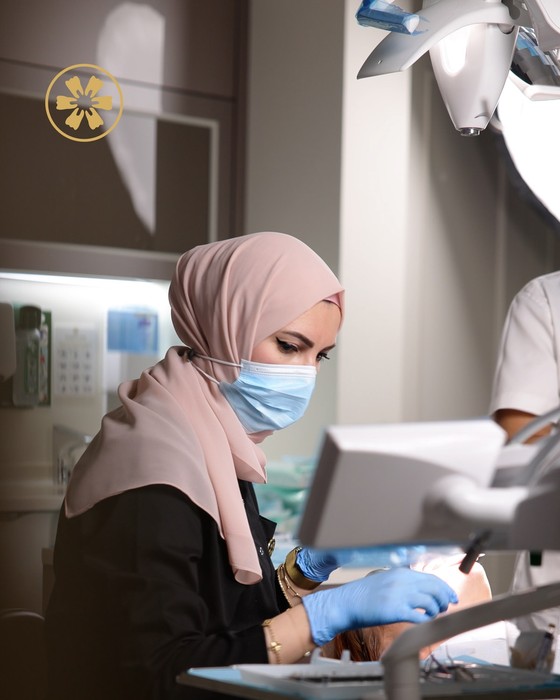
Reshape excess gum
When gum covers part of healthy teeth and makes them look short or uneven, the laser trims and sculpts the gum line. Our page on laser gum contouring covers this cosmetic use in detail.
A dental laser reshapes and removes gum tissue precisely, usually with little bleeding. It is a useful tool for the right problems, and an honest page should say just as clearly what it does not treat on its own.
Your gums are measured and the cause found first; the laser is chosen only when it suits the problem.
Laser gum treatment uses a dental laser to cut, reshape or remove soft gum tissue, usually sealing small blood vessels as it works, so bleeding is limited. At Creative Arts in Dubai it is used for soft-tissue work such as gum contouring and removing overgrown gum, and alongside cleaning where the dentist judges it useful. It does not replace deep cleaning for gum disease, which removes the tartar and biofilm causing it.
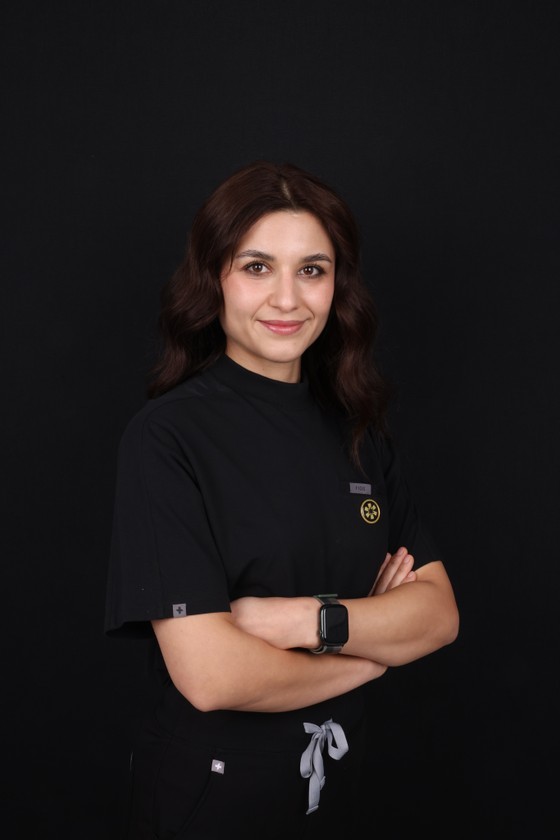
Who treats you here Dr. Duaa Ameen General Dentist · Dr. Taban Ameen Dentist
Every dentist’s licence can be checked on the DHA Sheryan medical directory.
Lasers work on soft tissue. These are the gum problems where a laser is a sensible choice, decided after examination.
When gum covers part of healthy teeth and makes them look short or uneven, the laser trims and sculpts the gum line. Our page on laser gum contouring covers this cosmetic use in detail.
Gum can thicken and grow over teeth, for example around braces or with some medicines. Once the cause is managed, the laser can remove the excess (gingivectomy) so the gum is easier to clean.
Where a filling or crown margin sits under the gum and only soft tissue needs adjusting, the laser can uncover the edge. If bone also needs reshaping, a different procedure is planned.
The dentist may use the laser on inflamed gum tissue alongside cleaning in particular areas. It is an addition to removing tartar and biofilm, never a substitute.
No. Gum disease is driven by bacterial biofilm and tartar on the tooth and root surfaces, above and below the gum line. Treatment works by removing them and keeping them off: professional cleaning, deep cleaning (scaling and root planing) where pockets have formed, and daily brushing and cleaning between the teeth at home. A laser cannot clean tartar off a root, and it does not rebuild bone that gum disease has already destroyed.
Lasers have been studied as an addition to that mechanical treatment. In 2018 the American Academy of Periodontology reviewed the evidence at a consensus meeting and reported that using a laser in addition to mechanical periodontal treatment gives similar or slightly better clinical outcomes, while noting that the evidence is not strong enough for definitive conclusions. That matches how we use it: as an option in selected areas, not as the treatment for periodontitis.
So if your gums bleed, feel tender or have pockets, the first step is charting and cleaning, often with Guided Biofilm Therapy below the gum line. Our pages on gum pockets and on gingivitis vs periodontitis explain the stages.
Each treats a different problem. Many people need more than one, in the right order.
| Treatment | What it does | Treats | At Creative Arts |
|---|---|---|---|
| GBT cleaning | Removes biofilm, stain and tartar above and just below the gum line | Gingivitis; maintenance after gum treatment | Offered |
| Deep cleaning (scaling and root planing) | Cleans root surfaces inside pockets under local anaesthetic | Periodontitis with pockets | Offered |
| Laser soft-tissue treatment | Reshapes or removes gum tissue; may be used alongside cleaning | Excess or overgrown gum; selected inflamed areas | Offered, when it suits the case |
| Surgical gum treatment | Opens the gum for direct access to deep pockets that did not respond | Advanced periodontitis after re-evaluation | May be considered; your dentist explains the options |
| Gum graft | Covers an exposed root with gum tissue | Some cases of gum recession | May be considered; see the gum graft guide |
The order usually runs from top to bottom: cleaning first, re-measurement, then anything further. Our gum treatment page explains the full pathway.
The laser suits soft-tissue problems in otherwise healthy, well-cleaned gums.
The laser procedure itself is often short. Most of the work is in diagnosis and preparation.
Your gums are measured around every tooth, bleeding is recorded and X-rays are taken where needed, so the cause of the problem is clear.
Visit 1If the gums are inflamed, cleaning and home-care changes come first. Healthy tissue gives a more predictable result.
Before the laserWhat will be treated, why the laser suits it, the alternatives and the aftercare, in writing before you decide.
Before treatmentUnder local anaesthetic, with protective glasses for you and the team, the dentist reshapes or removes the planned gum tissue.
Treatment visitWritten instructions for the first days, then a review to check healing and that the gum line has settled as planned.
Following weeksMost laser gum procedures are done under local anaesthetic, so you feel pressure and warmth rather than sharp pain during treatment. Because the laser usually seals small blood vessels as it works, there is typically little bleeding, and many soft-tissue procedures need no stitches. That is not the same as no discomfort: the treated gum is usually tender for a few days, and over-the-counter pain relief, taken as directed on the pack, is normally enough.
For the first days, soft food, avoiding very hot or spicy dishes on the treated side and gentle brushing as instructed help the gum heal. The surface usually looks healed within one to two weeks, and the gum line keeps settling over the following weeks, which is why any veneers or crowns planned after contouring are usually made once it has stabilised. If you smoke or use shisha, stopping during healing helps; our guide to smoking, shisha and your gums explains why.
Dr. Taban Ameen carries out laser and cosmetic gum work at Creative Arts, and Dr. Duaa Ameen looks after gum health, charting, cleaning and maintenance.
There is no single price for laser gum work, because the procedure depends on what is being treated. Your written plan sets out each item before you commit.
Clinical statements on this page are consistent with these independent sources. They describe averages from studies, not a promise for any one patient.
Most laser gum procedures are carried out under local anaesthetic, so during treatment you usually feel pressure and warmth rather than pain. Afterwards the treated gum is often tender for a few days, which over-the-counter pain relief usually controls. Because the laser seals small vessels, bleeding is typically limited, which many people find makes recovery easier.
Not on its own. Gum disease is caused by biofilm and tartar on the teeth and roots, and the treatment is removing them through cleaning or deep cleaning, then keeping them off at home. A laser may be used alongside that in selected areas, with evidence showing similar or slightly better results, but it cannot replace it.
If you have bleeding gums or pockets around the teeth, deep cleaning or professional cleaning is the treatment, and it comes first. Laser gum treatment is for soft-tissue problems such as excess or overgrown gum, or as an addition in selected areas. Charting your gums shows which applies, and some people need both, in that order.
The treated gum usually looks healed on the surface within one to two weeks, with tenderness easing after a few days. The gum line continues to settle over the following weeks. If veneers or crowns are planned after laser contouring, they are usually made once the gum has stabilised.
Contouring is one use of laser gum treatment: reshaping excess gum to change how much tooth shows, usually for appearance. Laser gum treatment is the wider term, which also covers removing overgrown gum, uncovering a restoration edge and use alongside cleaning in selected areas. Our gum contouring page covers the cosmetic side in detail.
No. A laser removes or reshapes gum tissue; it cannot make gum grow back over an exposed root. Receding gums are managed by finding and correcting the cause, protecting the exposed root, and in some cases a gum graft, which your dentist will explain if it may suit you.
Dr. Taban Ameen, whose work includes laser and cosmetic dentistry and gum treatment, carries out laser gum procedures, and Dr. Duaa Ameen looks after gum charting, cleaning and maintenance. Your gums are assessed before any laser treatment is suggested, and the plan is given to you in writing.
Creative Arts has a single clinic on Jumeira Street (Jumeirah Beach Road). Ask about parking when you book.
Our clinic in Jumeirah Open in Google Maps · Rated 4.8 on Google from 238 patient reviews (October 2026) — read them
Tell us what you would like to change. The clinic replies within working hours with an appointment time.
Or call us +971 4 342 4444Or message us on WhatsApp
A consultation ends with a diagnosis and a written, itemised plan — not a sales pitch. Book online, message us on WhatsApp, or call the clinic.