A dark line at the gum edge
A thin brown or black line hugging the gum, often with gums that look red or bleed when you brush.
Dark tartar is rarely just a cosmetic problem. At or below the gum line it usually means the gums are inflamed, and it needs professional removal, not scraping or whitening.
Tell us if you smoke or use shisha or medwakh; it helps plan the cleaning.


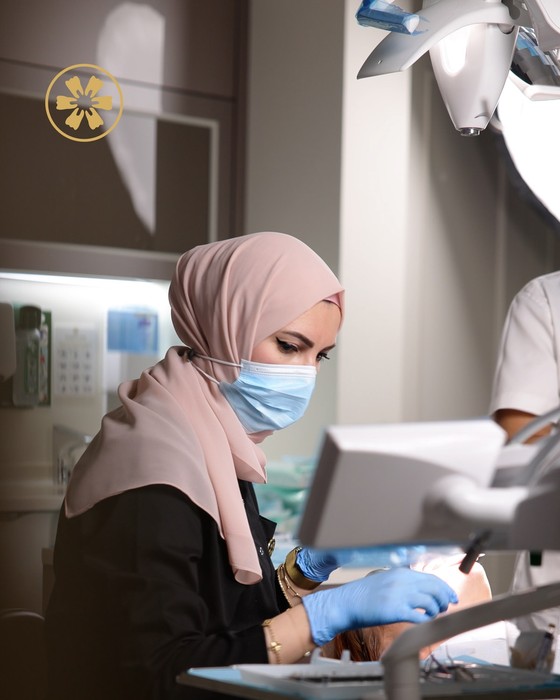
Photos of the equipment in our clinic in Jumeirah. They show how cleaning is done, not treatment results.
Black tartar usually forms below the gum line, where hardened plaque picks up dark pigment from blood in inflamed gums; it clings to the root and is often a sign of gum disease. Tartar above the gum can also turn brown or black from smoking, shisha, tea or coffee. Neither brushes off. At Creative Arts in Dubai it is removed professionally with air-polishing and ultrasonic scaling, after the gums are checked.
Who treats you here Dr. Duaa Ameen General Dentist · Dr. Julia General Dentist · Dr. Taban Ameen Dentist
Every dentist’s licence can be checked on the DHA Sheryan medical directory.
It is often easier to feel than to see, and usually appears where the gum meets the tooth.
A thin brown or black line hugging the gum, often with gums that look red or bleed when you brush.
Black spots between the teeth, especially as the gums shrink back and expose more of the root.
Your tongue feels a hard edge near the gum, or floss catches and shreds at the same spot.
On the inside of the lower front teeth in people who smoke or use shisha, where tartar builds fastest.
Several dark marks look alike in a mirror. An examination tells them apart.
| What you see | Likely cause | What it usually needs |
|---|---|---|
| A dark, hard line at or just under the gum; gums bleed | Tartar below the gum line, darkened by blood pigments | Professional cleaning; deep cleaning if pockets have formed |
| A brown-black crust behind the lower front teeth | Tartar above the gum, stained by smoking, shisha, tea or coffee | A professional clean with air-polishing and scaling |
| A thin black dotted line near the gum in a child with healthy gums | Black stain from pigment-producing bacteria, not tartar | Polishing; harmless but may return |
| A dark spot in a groove or between teeth that catches | Possible decay; see black spot on a tooth | Examination and X-ray; a filling if it is a cavity |
| A dark line at the edge of a crown | The crown margin, metal or decay; see dark line around a crown | Examination; repair or replacement if needed |
| Flat brown stain on smooth surfaces | Surface stain only | Air-polishing stain removal |
Tartar above the gum forms from minerals in saliva and is usually pale yellow. Below the gum, tartar forms from the fluid that seeps out of the gum pocket, which in inflamed gums contains blood. Breakdown products of that blood stain the deposit dark brown, green-black or black. That is why dark tartar is usually found exactly where gums are inflamed.
Tartar below the gum also tends to be harder and more firmly attached to the root than the deposits above it. Its rough surface holds bacteria against the root, which keeps the gum inflamed and can deepen the pocket, so the problem feeds itself. Many people first see it after the gum has shrunk back, or after a cleaning when the swollen gum settles and reveals deposits that were hidden.
For how tartar forms in general and why brushing cannot remove it, see our guide to tartar removal. This page is about the dark kind and what it signals.
Tobacco smoke, shisha and medwakh tar stain tartar above the gum brown or black, and many smokers build up tartar faster. The WHO names tobacco use, with poor oral hygiene, as a main risk factor for periodontal disease. There is an added catch: smoking reduces blood flow to the gums, so they bleed less and can look healthier than they are while disease progresses beneath the dark deposits.
If you smoke or use shisha, a shorter cleaning interval usually keeps build-up manageable, and the gums should be measured rather than judged by appearance. Our guide to smoking, shisha, vaping and your teeth covers the wider effects.
Picking at dark tartar with a metal tool can cut the gum and push deposits deeper, and it misses what lies below the gum. Book a visit soon if the gums bleed every time you brush, there is pus or a gum swelling, a tooth feels loose, or bad breath does not go away. The clinic is open daily, 10:00–20:00. Facial swelling with fever, or difficulty swallowing or breathing, needs a hospital emergency department straight away.
What you need depends on where the tartar sits and what the gums show when measured.
| Option | When it fits | What it involves |
|---|---|---|
| Professional clean with air-polishing | Stained tartar above the gum, healthy gum measurements | A GBT clean: stain and biofilm lifted with air, water and fine powder, then ultrasonic scaling of the tartar |
| Cleaning just below the gum | Dark tartar in shallow grooves, gingivitis | The same visit, with a fine tip reaching just under the gum where suitable |
| Deep cleaning | Pockets of 4 mm or more with bone loss | Deep cleaning of the root surfaces under local anaesthetic, then re-measuring |
| Maintenance | After treatment, or if you build tartar quickly | Shorter recall intervals and interdental cleaning at home |
Not sure which cleaning you need? Scaling vs deep cleaning explains how gum charting decides.
Removing long-standing dark tartar changes how teeth look and feel for a while.
Dr. Duaa Ameen, Dr. Julia and Dr. Taban Ameen carry out GBT cleaning and gum charting. Deep cleaning and gum maintenance are led by Dr. Duaa Ameen and Dr. Taban Ameen.
Clinical statements on this page are consistent with these independent sources. They describe averages from studies, not a promise for any one patient.
Often, yes. Dark tartar usually forms below the gum line, where blood from inflamed gums stains it, so it tends to sit exactly where the gums are unhealthy. It does not prove periodontitis on its own; pocket measurements and X-rays show whether there is bone loss and whether deep cleaning is needed.
No. Black tartar is hardened and bonded to the tooth, often below the gum, and no toothpaste or powder dissolves it. Abrasive products may lighten surface stain but can wear the exposed root next to the gum. Professional cleaning removes the deposit; whitening, if wanted, comes afterwards.
The spaces between the teeth are the hardest to clean, so plaque stays there longest, hardens and stains. Gum inflammation between the teeth adds blood pigments, and as the gums shrink back the dark deposits become visible. Daily interdental brushes or floss slow the build-up.
Usually because plaque is still being left at the gum line or between the teeth, because pockets remain where deposits re-form below the gum, or because smoking and shisha keep staining new tartar. Some people also form tartar quickly because of their saliva. Shorter cleaning intervals and interdental cleaning help.
Most people feel vibration, water and some sensitivity rather than pain, especially with air-polishing for the stain. Tartar deep below the gum is removed under local anaesthetic as part of deep cleaning. Teeth may be sensitive to cold for a few days afterwards.
Indirectly. Tartar below the gum keeps the gum inflamed, and over time that inflammation can destroy the bone that holds the teeth, which is what makes them loose. Removing the tartar and treating the gums stops that process. If a tooth already feels loose, see our page on loose teeth.
They stain tartar above the gum brown or black, and many smokers build tartar faster. Smoking also reduces bleeding from the gums, so gum disease beneath the deposits can be missed. Regular professional cleaning and gum measurements matter more if you smoke or use shisha.
Creative Arts has a single clinic on Jumeira Street (Jumeirah Beach Road). Ask about parking when you book.
Our clinic in Jumeirah Open in Google Maps · Rated 4.8 on Google from 238 patient reviews (October 2026) — read them
Tell us what you would like to change. The clinic replies within working hours with an appointment time.
Or call us +971 4 342 4444Or message us on WhatsApp
A consultation ends with a diagnosis and a written, itemised plan — not a sales pitch. Book online, message us on WhatsApp, or call the clinic.