What is Invisalign First, and is it right for my child?
Invisalign First is a version of Invisalign clear aligners designed for children aged roughly 6 to 10 who still have a mix of baby and adult teeth. It is used for early (Phase 1) treatment of problems such as crowding, spacing and a narrow upper jaw, and a second phase may still follow. At Creative Arts in Dubai, our specialist orthodontists first assess whether your child needs early treatment at all; many children only need monitoring.
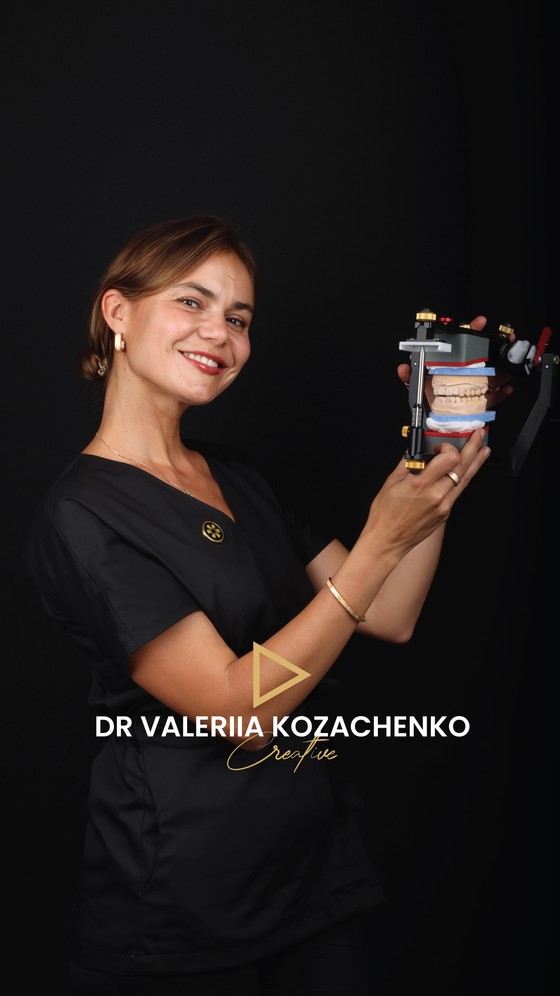
Who treats you here Dr. Muhannad Kazzaz Specialist Orthodontist · Dr. Valeriia Kozachenko Specialist Orthodontist
Every dentist’s licence can be checked on the DHA Sheryan medical directory.
What is Invisalign First, and how is it different from teen or adult aligners?
Invisalign First is a product line from the maker of Invisalign, intended for children in the mixed dentition stage, when the first adult molars and front teeth have come through but many baby teeth are still in place. Like any clear aligner, it is a series of thin, removable plastic trays made from a 3D scan of the teeth. Each tray is slightly different from the last, and wearing them in sequence moves the teeth a small step at a time.
What makes a children's system different is the mouth it has to work in. Baby teeth are short and rounded, so aligners grip them less well. Teeth are falling out and new ones are arriving during treatment, so the trays must leave room for erupting teeth. And the jaws are still growing, which is why early treatment usually focuses on making space and widening a narrow arch rather than placing every tooth in its final position.
That last point is the one parents most often miss. Early treatment, whether with aligners, a plate or a fixed appliance, is called Phase 1. It aims to correct a specific problem while growth can help. It is not designed to give a finished adult smile, because most of the adult teeth have not arrived yet. If you want to know how aligners work for older children, our page on Invisalign for teenagers covers that stage.
Invisalign First, a removable plate or a fixed appliance: how do they compare?
General characteristics of three common types of early appliance. Which one, if any, suits a child depends on the problem, the teeth present and how well the child will wear it.
| Clear aligners for children (e.g. Invisalign First) | Removable expansion plate | Fixed expander or partial fixed brace | |
|---|---|---|---|
| What it is | A series of clear trays changed on a schedule | An acrylic plate with clasps and a small screw that is turned to widen it | A device cemented to the back teeth, or brackets on a few front teeth |
| Main uses in early treatment | Arch widening, some crowding and spacing, aligning front teeth | Widening a narrow upper arch; moving one or two teeth | Widening the upper jaw; correcting a front tooth caught behind the lower teeth |
| Daily wear | About 20 to 22 hours; out only to eat and brush | Usually most of the day and night, as prescribed | Worn all the time; the child cannot remove it |
| Depends on the child wearing it | Yes, heavily | Yes, heavily | No |
| Visibility | Nearly invisible | Visible wire across the front teeth | Expander hidden in the palate; brackets visible |
| Eating and cleaning | Removed for meals; teeth brushed before trays go back in | Removed for meals and cleaning | Food traps around it; careful brushing needed |
| Speech | A slight lisp for a few days is common | Often a lisp for the first week or two | An expander can affect speech briefly |
No appliance replaces a diagnosis. Fixed expanders are used as part of orthodontic treatment where needed; removable plates are not among the treatments listed at Creative Arts.
What age is Invisalign First for?
The manufacturer describes Invisalign First as designed for children aged about 6 to 10 in Phase 1 treatment. Age is only a rough guide, though. What matters is the stage of tooth development: whether the first adult molars are through, how many front teeth have changed, and how much growth is left. Two eight-year-olds can be at quite different stages.
This matches the timing of a first orthodontic check. The American Association of Orthodontists recommends that children see an orthodontist no later than age 7, because the mix of baby and adult teeth at that age lets problems be spotted early. Spotting a problem is not the same as treating it, however. For most children the right advice is to wait and review. Our children's orthodontic assessment explains what is checked, and our guide to the best age for braces explains why many cases are better treated later in one phase.
Which problems can early aligner treatment help, and which can it not?
Early treatment is worth doing when waiting would make a problem harder to fix, or would put a tooth at risk. These are the usual situations, and the limits.
Narrow upper arch or crossbite
A narrow upper jaw can make the back teeth bite inside the lower ones. Widening the arch while the child is growing is one of the main reasons for early treatment; the orthodontist decides whether aligners or a fixed expander would do it more reliably.
Crowding that is blocking adult teeth
When there is clearly not enough room for the adult teeth coming through, creating space early can guide them in. Mild crowding of the front teeth at seven or eight is often normal and may improve as the jaws grow.
Front teeth at risk
Upper front teeth that stick out are more likely to be chipped in a fall. A Cochrane review found early two-phase treatment reduced new injuries to these teeth, with no other clear advantages over treating once in adolescence.
What aligners cannot do alone
Larger differences in how the upper and lower jaws are growing often need a functional appliance or later treatment. Teeth that have not erupted, are impacted or are missing need their own plan, and habits such as thumb sucking must stop for any appliance to hold.
What Creative Arts does and does not offer
At Creative Arts, our specialist orthodontists provide Invisalign clear aligners and fixed braces, mainly for teenagers and adults, and assess children around age seven to decide whether early treatment would help. Invisalign First and other early treatment for young children are not confirmed as services here. If your child needs early treatment, the orthodontist explains which appliance suits the problem, and whether it would be provided here or by referral.
How many hours a day must a child wear Invisalign First?
Aligners only move teeth while they are in the mouth, so the usual instruction is about 20 to 22 hours a day. In practice that means the trays come out only for meals and brushing, and go straight back in. For a young child, this is a family commitment as much as a dental one: a parent needs to check that trays go back in after lunch, are cleaned rather than wrapped in a napkin, and are worn at night.
School is where most trays get lost. A labelled case in the school bag, a habit of brushing or at least rinsing before trays go back in, and a plan for snacks all help. Sugary drinks with trays in place are a particular risk, because the liquid pools against the teeth under the plastic. Our guide to eating and drinking with Invisalign covers what is safe, and the reasoning behind the hours is in aligner wear time.
Children may also need small tooth-coloured bumps bonded to some teeth so the aligners can grip. Our guide to Invisalign attachments explains what they are and how they are removed.
Will my child still need braces later?
Possibly. Phase 1 deals with the problem that justified starting early. When the remaining adult teeth come through, usually by about 12 or 13, the orthodontist reviews the bite again. Some children then need a second, comprehensive phase with aligners or fixed braces to finish the alignment; others need only retainers and monitoring. The manufacturer itself describes Phase 2 as something that may follow if the doctor decides the child needs it.
Parents should ask about this before starting, because it changes the overall picture: two phases mean more appointments over more years. Early treatment is most worthwhile when it prevents a problem from becoming harder to fix, not simply when it is possible. Between phases, a retainer may be advised to hold the gains.
Not sure whether your child needs early treatment? Our specialist orthodontists in Dubai assess children around age seven and explain, in writing, whether to treat now, wait or simply review.
Orthodontics at Creative ArtsWhat should parents ask before early aligner treatment?
- What exactly is the problem, and what happens if we wait? If the honest answer is "not much", waiting is usually the better choice.
- Why aligners rather than an expander or another appliance? For some problems, a fixed appliance is more predictable because it does not depend on wear.
- How likely is a second phase? Ask for the orthodontist's view for your child specifically.
- What will my child have to do each day? Hours, cleaning, food and what to do if a tray is lost or breaks.
- Is there a habit to stop first? Thumb sucking or a tongue habit can undo the work; see our guide to thumb sucking.
- What about a gap between the front teeth? A gap in a seven-year-old is often normal and closes as the canines arrive; our guide to the gap between a child's front teeth explains when it is not.
If the problem involves the upper front teeth sticking out because the lower jaw is set back, a functional appliance may be discussed instead; our guide to Twin Block and functional appliances explains how they differ from aligners.
Who assesses children's orthodontics at Creative Arts
Children's orthodontic assessments are carried out by our specialist orthodontists, Dr. Muhannad Kazzaz and Dr. Valeriia Kozachenko.