What are removable braces, and do they work?
Removable braces usually means either a removable plate, an acrylic appliance with wires, or clear aligners. Plates can tip teeth, hold space and make limited changes in growing children, but cannot control tooth roots precisely, so they suit few adult cases. Clear aligners are also removable but are digitally planned and can correct far more. At Creative Arts in Dubai, specialist orthodontists provide Invisalign and fixed braces and explain which suits your teeth.
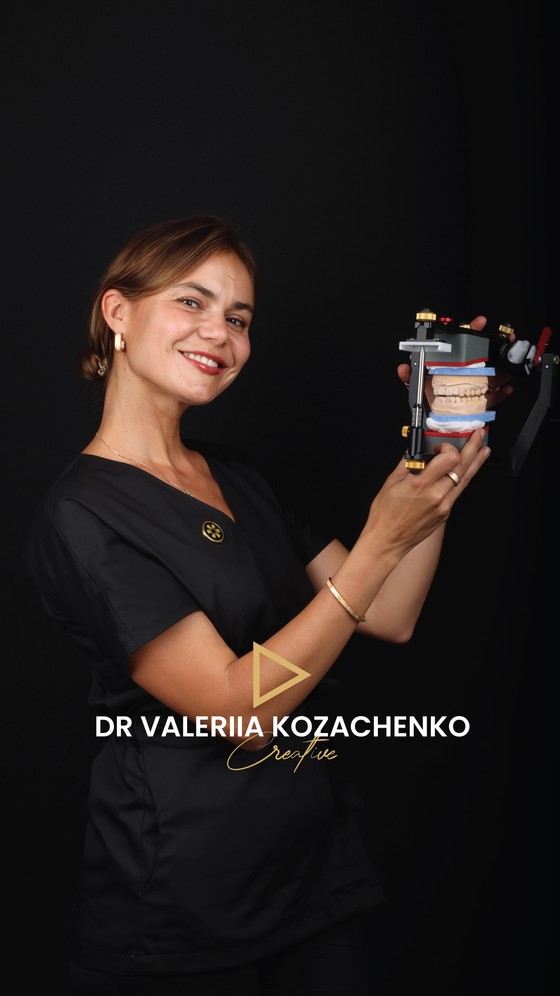
Who treats you here Dr. Muhannad Kazzaz Specialist Orthodontist · Dr. Valeriia Kozachenko Specialist Orthodontist
Every dentist’s licence can be checked on the DHA Sheryan medical directory.
What do people mean by "removable braces"?
The phrase is used for several different appliances, which is why advice about it often sounds contradictory:
- Removable plates. A pink or coloured acrylic base that sits against the roof of the mouth or behind the lower teeth, with wire clasps that grip the back teeth and springs or a bow that press on the teeth to be moved. Some include a small screw that is turned to widen the arch gradually.
- Functional appliances. Removable appliances, often in two parts, used in some growing children to influence how the upper and lower jaws relate. They are a specialist decision based on growth stage.
- Clear aligners. Thin transparent trays, such as Invisalign, that are changed every week or two and move the teeth in planned steps.
- Retainers. Removable plates or clear trays that hold teeth after treatment. They look similar but are designed to keep teeth still, not to move them.
In Arabic, «التقويم المتحرك» is used for both plates and clear aligners, so it is worth asking which one a clinic or article means.
Removable plate, clear aligners or fixed braces: how do they compare?
A general comparison. What suits your teeth depends on the problem, which a specialist assessment identifies.
| Removable plate | Clear aligners | Fixed braces | |
|---|---|---|---|
| What it is | Acrylic base with wire clasps and springs | A series of thin, clear plastic trays | Brackets bonded to the teeth, joined by a wire |
| How it moves teeth | Springs tip teeth; a screw can widen the arch | Each tray is shaped to the next planned position; attachments add grip | The wire guides teeth continuously in three dimensions |
| Root control | Limited: mainly tipping | Good for many movements when planned with attachments | Precise control of crowns and roots |
| Typical uses | Simple tipping, holding space, some changes in growing children | Crowding, spacing, relapse and many bite problems | The full range, including complex and severe cases |
| Visibility | Visible wires at the front; acrylic behind the teeth | Nearly invisible | Visible brackets |
| Depends on wear | Yes, entirely | Yes: about 20 to 22 hours a day | No; it works all the time |
| At Creative Arts | Not listed as a treatment | Provided with Invisalign | Provided |
Fixed and removable retainers after treatment are a separate topic; see our guide to how long to wear a retainer.
What can a removable plate do, and what can it not do?
A plate pushes on the crown of a tooth, the part you can see. Because it cannot grip the tooth firmly, the tooth tends to tip around a point partway down the root rather than move as a whole. That is useful for some jobs and a real limit for others.
Plates can be useful for:
- tipping a single front tooth over the bite when it is caught behind the lower teeth;
- gradual widening of a narrow upper arch in a growing child, using an expansion screw;
- holding space after a baby tooth is lost early;
- small tipping corrections where the root is already in a good position.
Plates cannot reliably:
- correct rotated teeth or move roots into line;
- close spaces while keeping the teeth upright and parallel;
- treat moderate or severe crowding across the arch;
- correct most bite problems in adults, whose jaws have stopped growing.
And like every removable appliance, a plate only works while it is in the mouth. Left in a drawer, it does nothing.
Do removable braces work for adults?
For adults, removable plates are rarely the right tool for straightening teeth. Adult jaws no longer grow, so the changes a plate can encourage in children are not available, and the tipping movements a plate makes are seldom what an adult case needs. A plate may still be used as a retainer after treatment.
When adults ask for removable braces today, what usually suits them is clear aligners. Aligners are removable for eating and cleaning, but they are planned digitally from a 3D scan, cover every tooth, and use small tooth-coloured attachments to turn and move teeth more precisely than a plate can. Our page on adult orthodontics explains what else is different when treating adults, including gum health and existing crowns and fillings.
Are removable braces used for children?
Removable appliances are used more often in children than in adults, because some problems can be influenced while the jaws are still growing. Examples include widening a narrow upper jaw, correcting a single front tooth caught in a crossbite, and some functional appliances for upper front teeth that stick out. Myofunctional trainers are a related idea; our guide to myofunctional appliances covers what the evidence shows.
Whether a child needs any early appliance at all is a specialist judgement. The American Association of Orthodontists recommends a first orthodontic check no later than age seven, and most children seen then only need monitoring. Our guide to the best timing for braces and our children's orthodontic assessment explain how that decision is made.
A removable appliance only works while it is worn
Plates and aligners both depend on the wearer. Plates are often prescribed for most of the day, and aligners for about 20 to 22 hours. Short wear, frequent removal and lost appliances are the most common reasons removable treatment falls behind. If you know you will struggle to wear something consistently, say so at the consultation, because fixed braces may suit you better.
Why are clear aligners different from a removable plate?
Both come out of the mouth, but that is where the similarity ends. A plate is a single appliance with springs that are adjusted by hand. Aligners are a sequence of trays, each made from a digital plan of where every tooth should be at that stage. Because each tray fits the whole tooth surface, and small composite attachments give it something to push against, aligners can rotate teeth, move roots and work on the bite in ways a plate cannot.
That does not mean aligners suit everyone. Some movements are still more predictable with fixed braces, and aligners need very consistent wear. Our guide to what Invisalign can fix sets out the limits, and the Invisalign vs braces comparison covers the choice between the two. For an overview of every appliance type, see types of braces.
Looking for braces you can take out? Invisalign clear aligners are removable for meals and cleaning, planned from a 3D scan and supervised by our specialist orthodontists in Dubai.
Explore InvisalignHow do you decide which appliance is right?
Start from the problem, not the appliance. A specialist orthodontist examines the teeth, bite and jaws, and then explains which appliance can make the movements you need and how predictable each option is. At Creative Arts, our specialist orthodontists, Dr. Muhannad Kazzaz and Dr. Valeriia Kozachenko, provide Invisalign clear aligners and fixed braces. Removable plates are not listed among our treatments; if the specialist thinks a different type of appliance would suit your child better, they explain why.
Useful questions to ask at any consultation:
- Which teeth need to move, and in what way: tipping, turning or moving roots?
- Is there a bite or jaw problem as well as crooked teeth?
- How many hours a day would I need to wear a removable appliance?
- What happens if the teeth do not move as planned?
- Which retainer will hold the result afterwards?
Specialist orthodontists who advise on appliances
Appliance choice at Creative Arts is made by our specialist orthodontists after an examination.