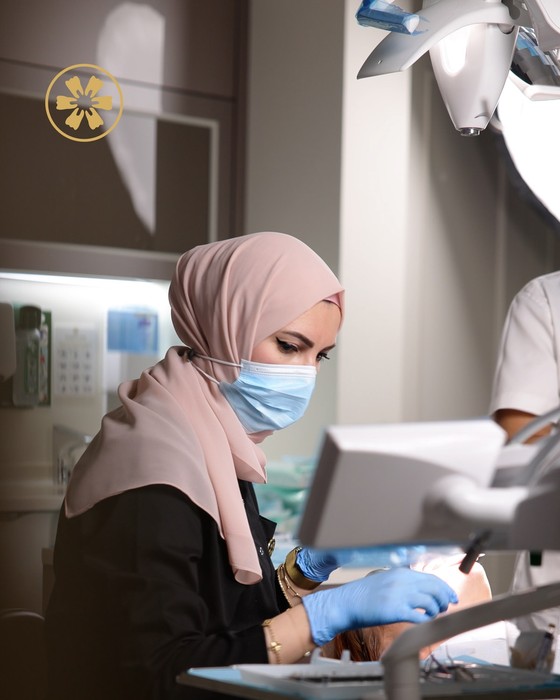
Will antibiotics cure a tooth infection?
Not on their own. Antibiotics for tooth infection can reduce swelling and stop an infection spreading, but the bacteria live inside a tooth whose nerve has died, or in a deep gum pocket, where the bloodstream cannot reach them. The infection usually returns until the source is treated by draining, root canal treatment or extraction. At Creative Arts in Dubai, antibiotics are prescribed only when needed, alongside treatment of the tooth.
Who treats you here Dr. Duaa Ameen General Dentist · Dr. Julia General Dentist · Dr. Marina Antoniuk Dentist
Every dentist’s licence can be checked on the DHA Sheryan medical directory.
Will antibiotics cure a tooth abscess?
A tooth abscess is a pocket of pus caused by bacteria. In most cases those bacteria come from inside the tooth: decay or a crack reached the nerve, the nerve died, and the empty space inside the root became a reservoir of bacteria that leak out of the root tip into the bone. Less often the source is a deep gum pocket around the tooth.
Antibiotics travel in the blood. They can reach the inflamed tissue around the tooth, which is why swelling and pain often improve within a few days. But a dead nerve has no blood supply, and pus and dense bone are hard for the drug to penetrate. The bacteria inside the root are protected, so when the course ends they multiply again and the abscess returns, sometimes larger. Our page on tooth abscess treatment explains how the source is dealt with.
This is why dental guidance puts treatment first. A guideline from the American Dental Association, summarised by the US Centers for Disease Control and Prevention, states that antibiotics are not needed for the urgent management of most dental pain and intraoral swelling in healthy adults, and recommends not prescribing them as an add-on when definitive dental treatment is available.
When are antibiotics for tooth infection actually needed?
A general guide to common situations. The decision is made by the dentist or doctor who examines you.
| Situation | Antibiotics usually needed? | What actually treats it |
|---|---|---|
| Toothache from deep decay, sharp pain with hot or cold | No; this is an inflamed nerve, not an infection antibiotics can treat | A filling, or root canal treatment if the nerve cannot recover |
| Abscess with swelling limited to the gum, treatment available | Usually no | Draining, then root canal treatment or extraction |
| Swelling spreading into the face, fever, feeling unwell | Yes, alongside urgent treatment of the source | Drainage and treatment of the tooth; hospital care if breathing or swallowing is affected |
| Dental treatment has to be delayed and the infection is active | Sometimes, as a short bridge | Treatment of the tooth as soon as it can be done |
| Gum abscess in a deep pocket | Usually no | Draining and cleaning the pocket |
| Inflamed gum over a wisdom tooth | Only if infection is spreading or you have a fever | Cleaning under the gum; removal if it keeps recurring |
| Dry socket after an extraction | Usually no | Cleaning the socket and a soothing dressing |
Why did the pain come back after antibiotics?
It is one of the most common stories in dental surgeries: a course of antibiotics, a week of relief, then the same tooth flares again. There are two usual explanations.
The source was never treated. The antibiotics reduced the infection around the tooth but not the bacteria inside it. Weeks or months later the balance tips again. Each round can destroy more bone around the root, which can make the tooth harder to save.
The pain was never an infection. Much toothache comes from an inflamed nerve (pulpitis) rather than an abscess. That pain often comes and goes on its own, so it can seem to respond to antibiotics when it was simply settling for a while. Antibiotics do not treat an inflamed nerve. Pain from a cracked tooth, grinding or the sinuses does not respond to them either; see sinus toothache if several upper teeth ache with a blocked nose.
A tooth that hurts again after antibiotics needs an examination and an X-ray, not another course.
When to get urgent help
Go to a hospital emergency department straight away if swelling spreads to your face, eye or neck; you have a fever or feel very unwell; or you have difficulty breathing, swallowing or opening your mouth. These are signs of a spreading infection that needs urgent treatment, not just tablets. For a painful or swollen tooth without these signs, contact the clinic during opening hours, daily 10:00–20:00; it is not a 24-hour service. See also swollen face from a tooth infection.
Can I get antibiotics for a tooth infection without seeing a dentist?
It is tempting to use leftover tablets, a family member's prescription or something recommended by a friend, especially when the pain starts late at night. It is not a safe shortcut:
- It may be the wrong treatment. If the pain is from an inflamed nerve, a crack or the sinuses, antibiotics do nothing for it.
- It can hide a spreading infection. A partial or unsuitable course can blunt the symptoms while the infection continues, delaying care that is needed.
- Medicines have risks. Allergic reactions, stomach upset and interactions with other medicines all happen, and the choice depends on your health, other medicines and, for women, pregnancy or breastfeeding.
- Unnecessary use drives resistance. Bacteria exposed to antibiotics they did not need to face become harder to treat, for you and for others.
Only take antibiotics prescribed for this episode by a dentist or doctor who has examined you, and take them exactly as instructed. If you are already on a course, do not stop or change it without asking the prescriber, and still book the dental treatment.
Toothache or swelling that keeps returning? See how tooth pain is examined, X-rayed and treated at the source at Creative Arts in Dubai, open daily 10:00–20:00.
General dentistryWhat actually treats a tooth infection?
Options from the most conservative to the most involved. Which fits depends on the X-ray, how much tooth is left and your wishes.
| Treatment | What it does | When it fits |
|---|---|---|
| Draining the abscess | Releases pus and pressure, often bringing quick relief | A swollen, tense abscess; usually the first step before definitive treatment |
| Root canal treatment | Cleans and seals the inside of the tooth so the bone around the root can heal | A tooth that can be restored and is worth keeping |
| Root canal retreatment | Redoes an earlier root canal that has become reinfected | Infection returning in a previously treated tooth |
| Gum pocket cleaning | Removes the bacteria and tartar feeding a gum abscess | When the infection comes from a deep gum pocket |
| Extraction | Removes the source completely | A tooth that is cracked through, too broken down to restore, or when you choose not to keep it |
| Antibiotics | Help control spreading infection | Only with fever, spreading swelling or when treatment must be delayed; always alongside the above |
If an extraction is the right choice, see tooth extraction for what is involved.
What helps until you can see a dentist?
The NHS suggests these steps for toothache until you can see a dentist: painkillers such as those sold at pharmacies, taken as directed on the label (a pharmacist can advise what suits you), rinsing with warm salt water for adults, eating soft food, and avoiding very hot, cold or sweet food and smoking. It advises seeing a dentist if toothache lasts more than two days or painkillers do not ease it, and emergency care if swelling around the eye or neck makes it hard to breathe, swallow or speak.
Other practical points: do not hold painkiller tablets against the gum, which can burn it; do not squeeze or prick a swelling; and keep brushing gently around the tooth. More home measures are in our guide to toothache relief at home. If the swelling is on the gum around one tooth rather than the face, see swollen gum around one tooth.
Dentists who treat tooth infections at Creative Arts
Dr. Duaa Ameen (general dentistry), Dr. Julia (general and microscopic dentistry) and Dr. Marina Antoniuk (restorative and root canal treatment) examine infected teeth, decide whether antibiotics are needed and treat the source.