

Does Invisalign hurt?
Invisalign usually causes pressure and tenderness rather than sharp pain. Each new aligner feels tight and the teeth are sore to bite for about one to three days, then it eases until the next aligner. Attachments and aligner edges can rub at first. A systematic review found Invisalign patients reported less pain than fixed-brace patients in the first days, with no difference later. At Creative Arts in Dubai, specialist orthodontists explain each stage and how to ease it.
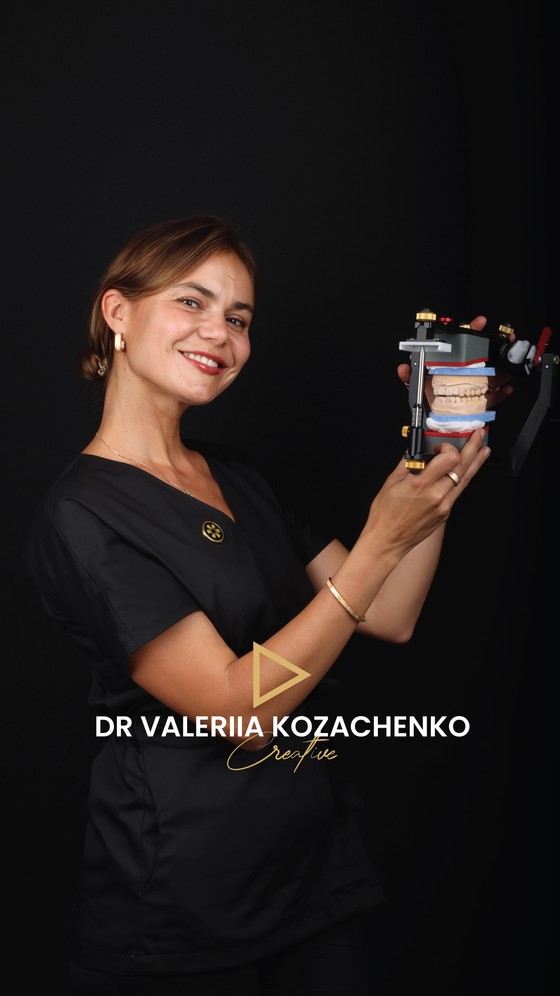
Who treats you here Dr. Muhannad Kazzaz Specialist Orthodontist · Dr. Valeriia Kozachenko Specialist Orthodontist
Every dentist’s licence can be checked on the DHA Sheryan medical directory.
What does Invisalign feel like?
Each aligner in an Invisalign series is shaped slightly differently from the position your teeth are in. When you put it on, it presses gently on the teeth it is designed to move, and that steady pressure starts the same bone remodelling that braces rely on. Our guide do braces hurt? explains that biology; the short version is that mild inflammation around the moving roots is what you feel as tenderness.
Most people describe it as tightness, a dull ache, or teeth that feel "bruised" when biting, rather than pain. Because the pressure is renewed with every new aligner, the sensation comes in short waves through treatment rather than one long spell at the start. Between those waves, most patients forget they are wearing aligners for much of the day.
When is Invisalign most likely to feel sore?
A typical pattern. Your orthodontist will tell you which stages apply to your plan.
| Stage | What happens | What most people feel | Usually lasts |
|---|---|---|---|
| First aligners | Treatment starts and the teeth begin to move | The most noticeable tightness and tenderness of the whole treatment | Two to three days |
| Each new aligner | A new aligner continues the planned movement | Tightness and tender biting, usually milder than the first set | About one to three days |
| Attachments placed | Small tooth-coloured bumps are bonded to some teeth | No injection needed; the bumps feel rough to the lips and tongue | A few days until you are used to them |
| IPR (enamel polishing) | Thin strips polish a fraction of a millimetre between selected teeth | Vibration and pressure; a little sensitivity for a day for some people | The appointment itself |
| Elastics, if used | Small rubber bands link upper and lower aligners to adjust the bite | Pressure on the hooked teeth and tired jaw muscles | A few days after starting or changing them |
| Refinement aligners | A short extra series fine-tunes the result | Similar to any new aligner | One to three days each |
| Retainers | Clear retainers hold the finished result | A snug feeling at first | A few days |
Discomfort that grows worse instead of easing, or focuses on one tooth, does not fit this pattern. See the warning signs below.
How long does Invisalign pain last?
For each new aligner, tenderness typically peaks in the first day and fades over one to three days. The very first aligners tend to feel strongest because the teeth and gums are not yet used to the pressure. As treatment goes on, most people find each change less noticeable.
Wear time affects comfort more than people expect. Aligners are designed to be worn about 20 to 22 hours a day; when they stay out for long meals or overnight, the teeth relax back slightly, and the aligner feels tight all over again when it goes back in. Consistent wear, explained in our guide to aligner wear time, keeps the pressure steady and the soreness short.
A simple trick many patients use is to switch to each new aligner at bedtime, so the tightest hours pass while asleep.
Do Invisalign attachments and IPR hurt?
Attachments are small shapes of tooth-coloured composite bonded to selected teeth so the aligners can grip and turn them. Placing them involves polishing and conditioning the tooth surface, applying composite through a template and setting it with a light. There is no drilling and no injection. Afterwards they feel rough to the lips and tongue for a few days, and aligners become firmer to take out, which is normal.
Interproximal reduction (IPR) creates a little space by polishing a fraction of a millimetre of enamel from between selected teeth, using thin abrasive strips or discs. Most people feel vibration and pressure rather than pain, and anaesthetic is not usually needed. Some notice mild sensitivity to cold for a day or so. It is planned in advance on your treatment simulation, so you will know beforehand whether your plan includes it.
Removing attachments at the end is quick and usually comfortable: the composite is polished away and the tooth surface smoothed.
What helps with Invisalign soreness?
Match the remedy to the kind of discomfort. Follow any specific advice from your orthodontist.
| What you feel | What usually helps | What to avoid |
|---|---|---|
| Tight, tender teeth after a new aligner | Start the aligner at bedtime, choose soft food for a day or two, sip cold water, and use over-the-counter pain relief as directed on the pack if needed | Taking the aligner out for long spells to get relief |
| A rough or sharp aligner edge | Orthodontic wax over the edge for now, then ask the clinic to smooth it | Cutting or trimming the aligner yourself |
| Attachments rubbing the lips or cheeks | Time: the tissue usually adapts within days; wax can help when aligners are out | Picking at the attachments |
| Soreness when removing aligners | Release the aligner from the back teeth first, one side then the other | Pulling it off from the front teeth |
| An aligner that does not seat fully | Bite gently on aligner seaters (chewies) for a few minutes, as your orthodontist advises | Moving on to the next aligner while the current one does not fit |
| Tired jaw from clenching on the aligners | Notice daytime clenching and rest the jaw: lips together, teeth apart | Chewing gum or biting hard on the trays |
If you take regular medication, are pregnant or have a medical condition, ask a pharmacist or your doctor which pain relief suits you.
Do not skip ahead or stop wearing aligners to avoid soreness
Jumping to the next aligner early adds force the teeth are not ready for, and leaving aligners out to rest makes the next fit tighter and can derail the plan. If an aligner is unusually painful, keep wearing the current one and contact the clinic for advice.
Does Invisalign hurt less than braces?
In the first days of treatment, often yes. A systematic review in Progress in Orthodontics found that patients treated with Invisalign reported lower pain than those with fixed braces during the first few days, while after that, up to three months, no difference was found. Aligners also avoid the rubbing brackets and poking wire ends that cause ulcers in the first weeks with fixed braces.
The trade-off is that aligner discomfort returns briefly with every new aligner, and the result depends on wearing them consistently. Comfort alone is rarely the right reason to choose: what matters more is which appliance can make the movements your teeth need. Our Invisalign vs braces comparison covers that decision, and what Invisalign can fix explains its limits.
Considering clear aligners but worried about discomfort? Our specialist orthodontists plan Invisalign from a 3D scan, show you every stage on a simulation, and explain what each step will feel like.
Explore InvisalignWhen is Invisalign discomfort not normal?
Ordinary aligner soreness affects several teeth, eases within a few days and is worst just after a change. Contact the clinic during opening hours, 10:00 to 20:00 daily, if you notice:
- one tooth that throbs, aches on its own, or is sensitive to hot and cold for more than a day or two;
- soreness that is still getting worse after three or four days on the same aligner;
- an aligner that has cracked and has a sharp edge, or that still does not fit snugly after a few days;
- gum swelling around one tooth, or a bad taste that does not go away;
- new clicking, locking or pain in the jaw joint, which can be checked through a TMJ assessment;
- swelling or irritation of the lips or gums that appears after starting aligners.
Lost or broken aligners are covered on our orthodontic emergencies page. Facial swelling with fever, or with difficulty breathing or swallowing, needs a hospital emergency department immediately.
The specialist orthodontists who supervise Invisalign
Invisalign at Creative Arts is planned and checked in person by our specialist orthodontists.