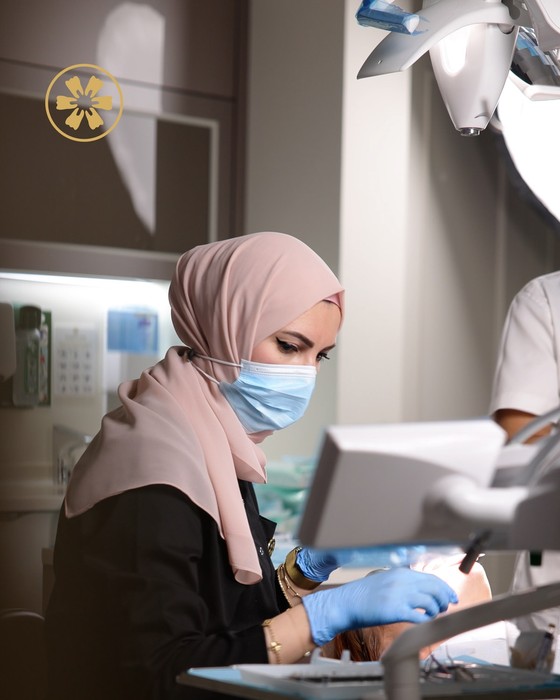
What is the sharp thing in my gum after a tooth extraction?
A sharp, hard piece in the gum after a tooth extraction is usually a bone spicule: a small flake of the thin socket wall that loses its blood supply and is pushed out as the bone heals. Less often it is a leftover piece of tooth or simply the edge of the socket. Small spicules often come out by themselves. At Creative Arts in Dubai, a dentist can remove a sore one quickly.
Who treats you here Dr. Duaa Ameen General Dentist · Dr. Julia General Dentist · Dr. Marina Antoniuk Dentist
Every dentist’s licence can be checked on the DHA Sheryan medical directory.
Why do bone fragments appear after a tooth extraction?
A tooth sits in a socket lined by a very thin layer of bone. When the tooth is removed, especially a back tooth with several roots or one that needed some surgical work, small edges or flakes of that socket wall can be left without a good blood supply. Over the following weeks the body remodels the socket: new bone fills it from below and the gum closes over the top. Any small piece of bone that is no longer alive is treated as a foreign body and gradually pushed up towards the surface.
That fragment is called a bone spicule, or a sequestrum when it is a detached piece. It typically shows up as a hard, sharp point or a white chip poking through the gum, often noticed with the tongue in the first few weeks after the extraction, though it can appear later. It is more common after molars, after several teeth are removed at once and after wisdom tooth removal.
A spicule is part of the normal clean-up of a healing socket. It does not mean the extraction was done badly, and on its own it is not an infection.
Is it a tooth piece or bone? How to tell what you are feeling
Several things can feel hard and sharp in a healing socket. These clues help; an examination, and sometimes an X-ray, confirms it.
| What it could be | How it looks and feels | When it appears | What it usually needs |
|---|---|---|---|
| Bone spicule | Small, rough, irregular white or yellowish chip; may wobble; sharp to the tongue | Days to a few weeks after the extraction | Often works out alone; quick removal if sore |
| Retained tooth fragment | Smooth and shiny like enamel, or darker root; may include old filling material | Can be felt early or after the gum shrinks | X-ray, then removal if it is loose, near the surface or causing trouble |
| Edge of the socket (bony ridge) | Firm ridge under thin gum, not moving | As the gum shrinks over the following weeks | Usually smooths as the bone remodels; trimmed only if it stays sore |
| Stitch | Thin thread or knot, sometimes stiff | From the day of the extraction | Dissolves or is removed at review; see stitches after an extraction |
| Trapped food | Soft, comes away with gentle rinsing | Any time while the socket is open | Gentle rinsing; see food in the extraction socket |
A greyish-white area deep in a painful, empty-looking socket two to four days after the extraction is more likely exposed bone from dry socket, which needs a different treatment.
Will the bone fragment come out by itself?
Often, yes. Small spicules commonly work their way through the gum over days to a couple of weeks and then fall out, sometimes while you eat or brush without you noticing. The gum underneath then closes. The questions are how much it bothers you while that happens, and whether it is actually a spicule.
While you wait:
- Leave it alone. Do not pick at it with fingers, tweezers or a toothpick, and try not to keep pushing it with your tongue. Pulling at a fragment that is still attached hurts, can tear the healing gum and lets bacteria in.
- Keep the area clean with gentle warm salt-water rinses after meals, from the day after the extraction or as your dentist advised, and brush the neighbouring teeth carefully.
- Chew on the other side and avoid hard, crunchy food that presses on the spot.
- Use pain relief only as directed on the label or by your pharmacist if the area is tender.
If the sharp edge is rubbing your tongue or cheek, a dentist can check it rather than waiting; removing a loose spicule usually takes a few minutes.
Normal healing or a reason to see the dentist?
Most spicules need nothing more than patience. These signs mean the socket should be looked at.
| Usually normal | See a dentist | |
|---|---|---|
| The fragment | A small sharp point that is slowly rising or loosening | Still there and sore after about two weeks, or getting bigger |
| Pain | Mild tenderness when you touch it | Pain that is increasing, throbbing or waking you |
| Gum around it | Slightly pink, closing over the socket | Red, swollen, with pus, a bad taste or a gum boil |
| Tongue or cheek | Occasional awareness of the point | A sore or ulcer where the sharp edge rubs |
| Healing overall | Socket filling in week by week | Healing that stalls, or a fragment you suspect is part of the tooth |
Our guide to the stages of extraction healing shows what the socket normally looks like week by week.
Had a tooth out and something sharp will not settle? See how extractions, surgical extractions and post-operative reviews are handled at Creative Arts.
Oral surgery at Creative ArtsWhen should the dentist remove the bone fragment, and how?
A dentist will usually remove a fragment that is loose and sore, rubbing the tongue or cheek, surrounded by inflamed gum, or not coming out on its own after a couple of weeks. An X-ray is taken if there is any doubt about whether it is bone or tooth, or if a root tip might be left deeper in the socket.
Removing a loose spicule is a small job. The area may be numbed with a gel or a little local anaesthetic, and the fragment is lifted out with fine instruments; there is often no need for stitches. If a sharp ridge of bone remains under the gum and keeps causing soreness, it can be smoothed. A retained piece of root is not always taken out: a small, deep root tip with no infection is sometimes left and monitored, because removing it could disturb more bone than it saves. That decision is made with you after the X-ray.
If an implant is planned for the site, mention any fragment at your next visit so the socket can be assessed before planning.
When to get help quickly
Contact the dentist soon if swelling, pain or a bad taste is getting worse after the third day, if there is pus, or if you have a fever. Bleeding that does not slow after firm pressure on a gauze pad for 30 minutes also needs advice. The clinic is open daily, 10:00–20:00, without an overnight service. Go to a hospital emergency department for facial swelling with difficulty breathing or swallowing, or swelling spreading towards the eye or neck.
Can bone fragments be prevented, and who checks them at Creative Arts?
Careful technique and smoothing sharp edges at the end of an extraction reduce spicules, but they cannot always be avoided, because the body decides which thin pieces of bone survive. Keeping the socket clean, not smoking and following the written aftercare help the socket heal smoothly, and a review appointment catches anything sharp early.
At Creative Arts, Dr. Duaa Ameen, Dr. Julia and Dr. Marina Antoniuk review healing sockets and remove loose fragments, and surgical cases are referred within the oral surgery team. If your extraction was done elsewhere, you can still have the socket examined during opening hours; bring any X-rays or notes you were given. For upper back teeth, also read about a sinus opening after an extraction, which feels very different from a spicule.
Dentists who review healing extraction sites
Dr. Duaa Ameen, Dr. Julia and Dr. Marina Antoniuk examine sockets that feel sharp or slow to heal, take X-rays when needed and remove loose fragments.