Clenching and grinding
Night-time grinding and daytime clenching load the joints and tire the chewing muscles. Many people do not know they do it until a partner hears it or teeth show wear.
A click from the jaw joint is very common and, on its own, usually harmless. It deserves a closer look when it comes with pain, catching or locking, or a jaw that will not open fully.
Note when the clicking happens and whether it hurts or catches; it helps the assessment.
Jaw clicking without pain is common and usually does not need treatment. It is often caused by the small disc inside the jaw joint slipping forward and clicking back into place as you open. Get it checked if the click comes with pain, the jaw catches or locks, opening is limited or the bite feels different. At Creative Arts in Dubai, a specialist orthodontist carries out TMJ assessments and starts with conservative care.
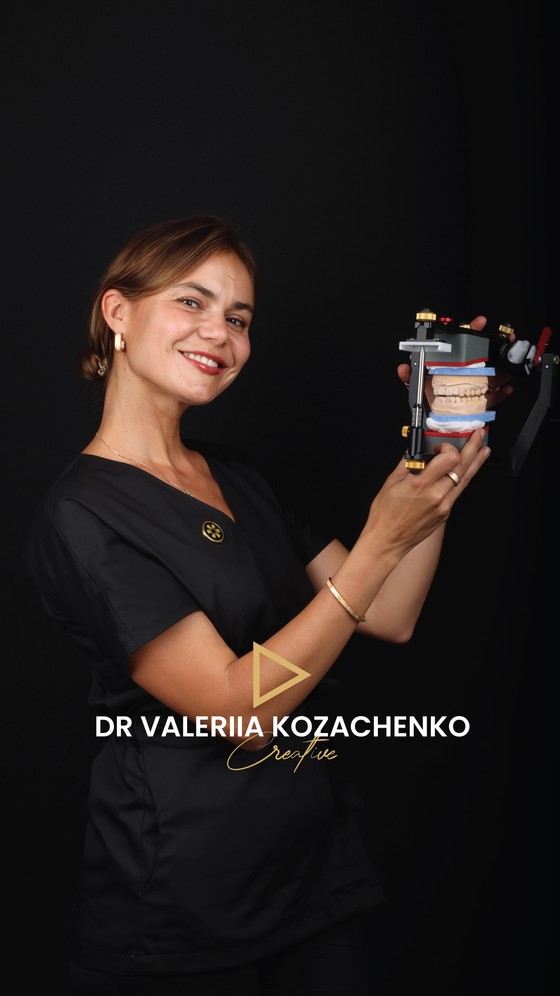
Who treats you here Dr. Valeriia Kozachenko Specialist Orthodontist · Dr. Firas Osman Oral & Maxillofacial Surgeon & Implantologist
Every dentist’s licence can be checked on the DHA Sheryan medical directory.
Each jaw joint sits just in front of the ear, where the lower jaw meets the skull. Between the two bones is a small, flexible disc that acts as a cushion. When you open wide, the head of the jaw does not just hinge; it also slides forward, and the disc is meant to travel with it.
In many people the disc sits slightly too far forward. As the mouth opens, the jaw slides under the edge of the disc and snaps back onto it, which is the click you hear or feel. On closing, it may slip off again with a softer second click. This is called disc displacement with reduction, and it is the most common reason for a clicking jaw. If it does not hurt or interfere with eating, it is generally considered a normal variation.
Other sounds have other causes. A grating or crunching noise, rather than a single click, can reflect wear of the joint surfaces. A loud clunk at the end of a wide yawn can come from a jaw that moves further forward than usual.
A practical guide. Only an examination can confirm what is happening in your joint.
| What you notice | What it often means | What to do |
|---|---|---|
| A click on opening, no pain, eating normally | Disc slipping and returning; very common | Usually nothing; avoid very wide yawning and gum chewing if it bothers you |
| Clicking with pain in front of the ear or in the cheek muscles | Joint or muscle strain, often with clenching or grinding | Self-care for a week or two; book an assessment if it does not settle |
| The jaw catches and you have to wiggle it to open | The disc is not returning smoothly every time | Book a TMJ assessment |
| Clicking stopped, but now you cannot open fully | The disc may no longer be returning (closed lock) | Book a prompt assessment; do not force the mouth open |
| Grating or crunching sounds with ache | Possible wear in the joint | Book an assessment |
| The jaw is stuck open and will not close | The jaw has moved out of the joint (dislocation) | Go to a hospital emergency department |
| Clicking or pain after a blow to the face | Possible injury to the joint or jaw | Hospital first if severe pain, swelling, bleeding or a change in bite |
A tooth that clicks or moves when you push it with your tongue is a different problem: that is a loose tooth, not the jaw joint, and should be checked by a dentist.
A clicking joint usually has more than one contributor. These are the ones an assessment looks at.
Night-time grinding and daytime clenching load the joints and tire the chewing muscles. Many people do not know they do it until a partner hears it or teeth show wear.
Yawning widely, biting into large sandwiches, chewing gum for long periods and long dental appointments can all aggravate a joint that already clicks.
A blow to the jaw, a fall onto the chin or a whiplash-type injury can change how the disc moves.
Stress tends to increase clenching and muscle tension, which is why jaw symptoms often flare in busy or difficult periods.
the click comes with pain that does not settle within a couple of weeks; the jaw catches, locks or will not open as far as before; your bite suddenly feels different; you have swelling in front of the ear, fever or numbness; or it started after an injury. If the jaw is stuck open and will not close, or there was a significant blow to the face, go to a hospital emergency department. The clinic is open daily from 10:00 to 20:00 and is not a 24-hour service.
From the simplest to the most involved. Most people improve with the first rows, and a click without pain usually needs none of them.
| Option | When it fits | What it involves |
|---|---|---|
| Reassurance and monitoring | Clicking without pain, with normal opening | Understanding what the click is and what would change the plan |
| Self-care | Mild pain or tiredness in the jaw | Softer food for a while, small bites, avoiding gum and wide yawns, heat or cold packs, and noticing daytime clenching |
| Night guard or splint | Grinding or clenching, especially with morning jaw ache | A custom appliance worn at night to protect teeth and reduce load; see night guards |
| Physiotherapy and exercises | Muscle pain, stiffness or limited movement | Guided exercises and manual therapy, often by a physiotherapist with experience in jaw problems |
| Orthodontics | When a bite problem is part of the picture and needs correcting for its own sake | Planned only after the joint has been assessed; not a routine treatment for clicking |
| Surgical opinion | Rare cases of persistent locking or pain that do not respond to other care | Assessment by an oral and maxillofacial surgeon of procedures on the joint |
Treatments that permanently change the teeth or bite, such as grinding teeth down or extensive crowns, are not recommended as a first step for jaw clicking.
Not necessarily. A night guard or splint protects the teeth from grinding and can ease muscle and joint pain for some people, but it does not reliably stop a click, and reviews have found too little evidence that splints reduce grinding itself. That is why a splint is discussed after an assessment, as one part of care, rather than offered automatically to everyone whose jaw clicks.
If you grind your teeth, a guard is still worth considering for the teeth alone. For the wider range of options and how they are combined, see our guide to TMJ treatment options, and for which professional does what, who treats TMJ problems.
The aim is to understand what the joint and muscles are doing, and whether anything needs treating at all.
When the clicking started, whether it hurts, catches or locks, and any injury, headaches or grinding.
Visit 1Listening to and feeling the joints, measuring how wide and how straight the jaw opens, and checking the chewing muscles.
Visit 1Looking for wear from grinding and assessing the bite, which matters for planning even when it is not the cause.
Visit 1X-rays or 3D imaging when the findings suggest a structural problem; not everyone needs them. MRI, when indicated, is arranged through referral.
If indicatedAn explanation of what is happening and a step-by-step plan starting with conservative care, with reviews to check progress.
Visit 1–2Dr. Valeriia Kozachenko, Specialist Orthodontist with a focus on TMJ and jaw function, carries out TMJ assessments and plans conservative care. Dr. Firas Osman, Oral & Maxillofacial Surgeon & Implantologist, gives a surgical opinion in the rare cases where it is needed.
Clinical statements on this page are consistent with these independent sources. They describe averages from studies, not a promise for any one patient.
Yes, for most people. Clicking or popping without pain, with normal opening and chewing, is common and is generally considered a normal variation that does not need treatment. It is worth a check if pain, catching, locking or limited opening develop later, or if the clicking started after an injury.
Each jaw joint has its own disc, so it is common for only one side to click. Chewing moves the jaw forward and sideways, which can make a slightly displaced disc on one side slip and return with a click. If it does not hurt, it usually needs no treatment; if it hurts or catches, a TMJ assessment can clarify why.
It can. Jaw symptoms often improve without treatment, and clicking sometimes becomes quieter or stops over time. Clicking that stops suddenly and is replaced by difficulty opening the mouth is different, because the disc may no longer be returning to place, and that should be assessed promptly.
Orthodontic treatment is not a routine treatment for jaw clicking, and evidence that changing the bite cures joint noises is weak. Orthodontics may be planned when a bite problem needs correcting for its own sake, and the joints are assessed beforehand. Conservative care comes first for clicking or jaw pain.
Very rarely. Surgery is considered only when locking or pain persists and has not responded to well-managed conservative care, and the findings show a structural problem in the joint. In those cases, an oral and maxillofacial surgeon assesses the joint and explains the options and where any procedure would take place.
A dentist with experience in jaw joint problems is a good first step. At Creative Arts, Dr. Valeriia Kozachenko, a specialist orthodontist with a focus on TMJ and jaw function, carries out TMJ assessments, with a surgical opinion from Dr. Firas Osman when needed. Physiotherapists and doctors also play a role for some patients.
Creative Arts has a single clinic on Jumeira Street (Jumeirah Beach Road). Ask about parking when you book.
Our clinic in Jumeirah Open in Google Maps · Rated 4.8 on Google from 238 patient reviews (October 2026) — read them
Tell us what you would like to change. The clinic replies within working hours with an appointment time.
Or call us +971 4 342 4444Or message us on WhatsApp
A consultation ends with a diagnosis and a written, itemised plan — not a sales pitch. Book online, message us on WhatsApp, or call the clinic.