The same spot, every meal
Meat fibres, seeds or rice lodge between the same two teeth, and you reach for a toothpick or floss each time.
Food that catches in the same place after every meal is usually telling you something: a gap where two teeth no longer touch, a cavity, a worn filling or a gum change. Most causes are simple to fix.
Tell us which teeth catch food and whether flossing there shreds or hurts.
Food that catches in the same spot every time usually means the two teeth there no longer meet tightly. Common causes are a cavity between the teeth, a worn or poorly shaped filling or crown, teeth that have drifted apart, or gums that have shrunk back. Left trapped, food feeds decay and inflames the gum. At Creative Arts in Dubai the contact is checked with floss and X-rays and the cause repaired, often with a filling.
Who treats you here Dr. Duaa Ameen General Dentist · Dr. Julia General Dentist · Dr. Marina Antoniuk Dentist
Every dentist’s licence can be checked on the DHA Sheryan medical directory.
Most people notice it as a habit before they notice it as a problem.
Meat fibres, seeds or rice lodge between the same two teeth, and you reach for a toothpick or floss each time.
A dull ache or feeling of fullness between teeth after eating, which goes once the food is removed.
Shredding suggests a rough edge or cavity; floss that slides through with no resistance suggests the teeth no longer touch.
The gum between the teeth becomes tender, swollen or bleeds when brushed, because food keeps pressing into it.
Trapped food breaks down quickly. A smell from one spot is a reason to look closer there.
Healthy neighbouring teeth touch at a tight point called the contact. Floss should click through it, and chewing pushes food over it rather than into it. When that contact opens or roughens, food is driven down into the gap with every bite. The usual reasons are:
Food around a part-erupted wisdom tooth is a different problem: the flap of gum over it can become infected, which is called pericoronitis.
Gentle, specific tools work better than force. If the food will not come out, or keeps coming back, book a check rather than digging at it.
| Do | Why | Avoid |
|---|---|---|
| Slide floss down and out sideways, curving it around each tooth | Lifts food out without snapping into the gum | Snapping floss down hard into the gum |
| Use an interdental brush that fits the gap | Cleans spaces where floss slips through without resistance | Forcing a brush that is too big |
| Rinse firmly with warm water, or use a water flosser | Flushes out loose pieces, especially around bridges and crowns | Relying on rinsing alone every day |
| Brush and floss that area every day while you wait | Keeps the gum from becoming inflamed | Leaving food in place overnight |
| Book an examination if it keeps happening | A recurring food trap usually has a cause that can be fixed | Pins, knives or other sharp objects |
Our guide to flossing and water flossers shows the technique step by step.
Contact the clinic during opening hours, 10:00 to 20:00 daily, if the area throbs, the gum is swollen or there is a bad taste that does not clear. Go to a hospital emergency department straight away for facial swelling with fever, difficulty breathing or swallowing, swelling spreading to the eye or neck, or bleeding that will not stop.
The aim is to find out why the contact has opened, not only to clean the gap.
The dentist checks whether floss snaps through, slides through loosely or shreds, which points to a gap, an open contact or a rough edge.
Fillings, crown edges and the gum are checked for overhangs, chips, cracks and inflammation.
Small X-rays show decay between teeth and overhanging fillings that cannot be seen directly.
Where the gum is involved, pocket depths are measured to see whether gum treatment is needed.
You are told the cause and the options, from the simplest fix up, before anything is done.
Options from the simplest to the most involved. Many people need only the first one or two.
| Cause | Usual fix | Where to read more |
|---|---|---|
| Plaque and inflamed gum, contact still sound | Professional cleaning and the right interdental brush | Teeth cleaning |
| Rough or overhanging filling edge | Smoothing and polishing the edge | Fillings |
| Cavity between the teeth | Removing the decay and a composite filling shaped to touch the next tooth | Fillings |
| Worn or flat filling with an open contact | Replacing or adding to the filling to rebuild a tight contact | White vs silver fillings |
| Poorly fitting or open-edged crown | A new crown made to meet the neighbouring tooth | Crown replacement |
| Gum recession or pockets | Gum treatment and tailored cleaning aids | Gum treatment |
| Teeth that have drifted apart | Orthodontic closure, sometimes bonding for a small space | Gaps between teeth |
A new filling or crown is only useful if the cause is the tooth's shape; it will not fix a food trap caused by gum disease alone.
A recurring food trap deserves attention, but the fix should match the cause.
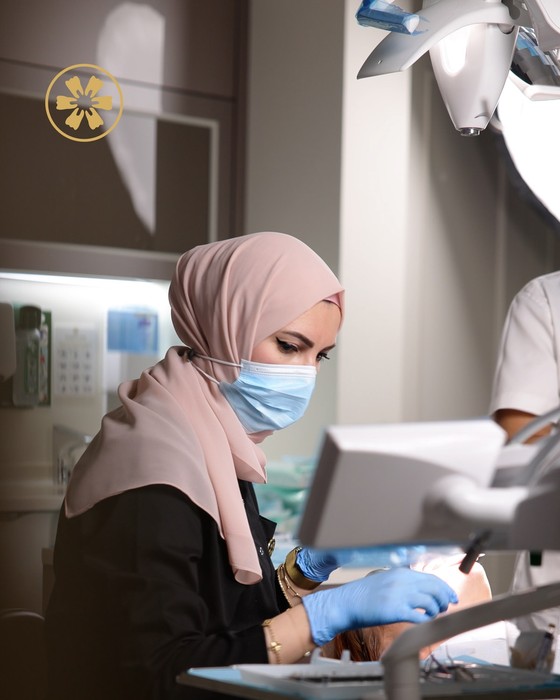
Dr. Duaa Ameen, Dr. Julia and Dr. Marina Antoniuk check contacts, fillings and gums and repair the cause.
It can be. Decay on the side of a tooth opens the contact with its neighbour, so food starts to catch there. Food trapping can also come from an old filling, drifting teeth or receding gums. Bitewing X-rays show decay between teeth that cannot be seen in a mirror, so a recurring food trap is worth an examination.
Floss that shreds or tears in one place usually catches on something rough: a chipped or overhanging filling edge, a crown margin, tartar or a cavity. It is a useful sign to mention to your dentist. Often the edge can simply be smoothed; if decay is found, a filling is usually enough.
Yes. Food pressed repeatedly into the gum between two teeth inflames it, and a piece lodged under the gum, such as a husk or seed, can cause a sore, swollen spot. Remove it gently with floss or a water flosser. If the swelling or pain does not settle within a day or two, have it checked.
Usually, yes. If the gap is caused by decay or a worn filling, a new composite filling shaped to touch the next tooth often closes the contact. A poorly fitting crown may need replacing. Spaces from drifting teeth are sometimes best closed with orthodontics, and gaps from gum recession are managed with gum care and cleaning aids.
A crown that does not touch its neighbour firmly, or has an edge that is not flush with the tooth, can trap food. Decay starting at the edge of a crown can also open a space. Have it checked rather than waiting, because decay under a crown can progress without pain.
A water flosser is good at flushing out loose food and helps around bridges, crowns and braces. It does not remove sticky plaque as well as floss or interdental brushes, so it works best alongside them. And it will not fix the cause of a recurring food trap.
Creative Arts has a single clinic on Jumeira Street (Jumeirah Beach Road). Ask about parking when you book.
Our clinic in Jumeirah Open in Google Maps · Rated 4.8 on Google from 238 patient reviews (October 2026) — read them
Tell us what you would like to change. The clinic replies within working hours with an appointment time.
Or call us +971 4 342 4444Or message us on WhatsApp
A consultation ends with a diagnosis and a written, itemised plan — not a sales pitch. Book online, message us on WhatsApp, or call the clinic.