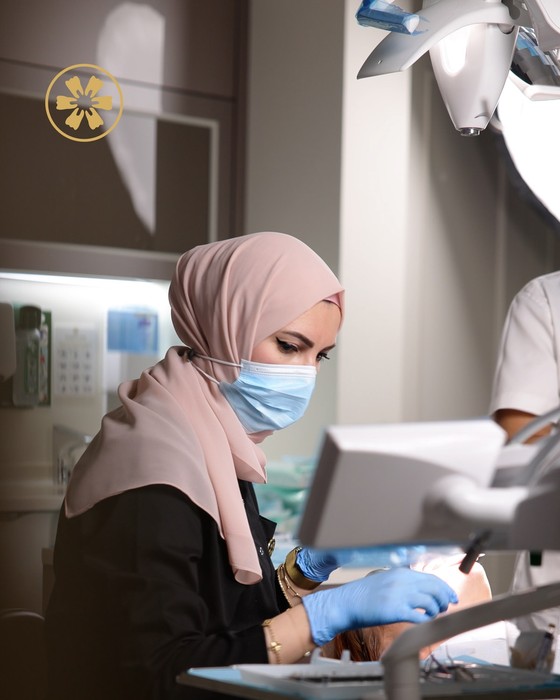
Gel stays on the teeth
A tray made from a scan sits close to every tooth, so a small amount of gel covers the enamel instead of leaking onto the gums, where it causes soreness.
Thin trays made from a scan of your teeth, a prescribed gel and clear instructions. Slower than an in-clinic session, usually gentler on sensitive teeth, and easy to top up later.
We check the cause of the discolouration, your gums and any restorations before trays are made.
Your dentist scans your teeth, has thin trays made that fit them closely, and prescribes a lower-strength whitening gel. You place a small amount in the trays and wear them daily for a set time, usually over one to two weeks, and then the shade and gums are reviewed. At Creative Arts in Dubai you keep the trays afterwards for occasional top-ups.
The gel does the whitening; the tray decides where the gel goes.
A tray made from a scan sits close to every tooth, so a small amount of gel covers the enamel instead of leaking onto the gums, where it causes soreness.
Strips and boil-and-bite trays miss the surfaces of rotated or crowded teeth, which then whiten patchily. A custom tray follows each tooth.
With a close fit, a drop per tooth is enough, so there is less irritation and usually milder sensitivity.
The same trays are used for top-ups later, as long as your teeth do not change shape with new crowns, veneers or orthodontic movement.
Wear time and course length are set for your teeth and gel; the stages are the same for everyone.
We find out what is causing the discolouration, check gums and fillings, and note crowns or veneers that will not change. Decay or gum inflammation is treated first.
Visit 1An intraoral 3D scan records your teeth, the thin trays are made from it, and your starting shade is recorded.
Visit 1We check the fit, show you how much gel to use and how to remove the excess, and give written instructions.
Visit 2You wear the trays for the prescribed time each day, during the day or overnight depending on the gel. Most people see change within a few days.
Usually 1–2 weeksShade, gums and sensitivity are checked. If you want to go lighter and the teeth are comfortable, the course can be extended.
End of courseTypical ranges; your written instructions are specific to your teeth and gel.
Deeper stains, such as grey tetracycline banding, can need longer courses and respond less predictably.
Keep the gel somewhere cool and away from children. If a tooth becomes sensitive, skip a day or shorten the wear time rather than stopping altogether, and tell us; the whitening sensitivity guide explains what helps.
Both put a whitening product against your teeth; what happens around that differs.
| Dentist-supervised trays | Typical shop kit | |
|---|---|---|
| Cause of staining checked | Yes, at the examination | No — the kit assumes whitening will work |
| Fit | Made from a scan of your teeth | Strips or one-size trays |
| Gel | Prescribed professional whitening gel | Varies widely; some contain little or no peroxide |
| Gum contact | Minimal, with excess wiped away | Common with loose trays |
| Crowded or rotated teeth | Covered evenly | Often missed, giving patchy results |
| If sensitivity starts | Wear time or gel adjusted with your dentist | Up to you |
Strips, charcoal powders and DIY remedies carry their own risks, from abrasion to gum burns. The guide to whitening product safety covers them one by one.
Most people notice the first change within a few days of daily wear, with the main result over one to two weeks. Yellow-brown staining from age, coffee and tea responds quickest. Grey tetracycline staining, or teeth that are naturally deeper in colour near the gum, can take longer and may not reach the same lightness; longer courses are sometimes used for these, with reviews along the way.
Teeth look slightly brighter straight after each session because they are dehydrated, so judge the shade in daylight the next morning. If bonding or veneers are planned, the shade is usually left to settle for about two weeks before it is matched. Teeth pick up stain most easily during the course itself, so the after-whitening diet applies throughout, not only at the end.
Whitening is not permanent; coffee, tea, smoking and time bring some colour back. Keeping your trays means a few top-up applications, on your dentist's advice, can maintain the shade instead of repeating a full course, while regular professional cleaning removes new surface stain. Trays need remaking if your teeth change shape, for example after new crowns. The main teeth whitening page compares every option.
Your trays are prescribed and reviewed by a dentist at Creative Arts in Dubai, who checks what is causing the discolouration before anything is made.
It depends on the gel prescribed. Some home whitening gels are worn for a set period during the day, others overnight, and your written instructions give the exact time. Overnight gels work slowly over several hours; daytime gels are stronger and meant for shorter wear, so never swap them. Wearing trays longer than prescribed mainly increases sensitivity and gum irritation.
For most people, yes, because the cause of the staining is checked first and the tray holds the gel on the teeth rather than the gums. Shop kits vary widely in what they contain, strips miss crowded teeth, and loose trays leak gel. A kit also cannot tell you that your discolouration will not respond to whitening at all.
Use only the gel your dentist prescribed for those trays. Products bought online can have unknown strengths or acidic ingredients, and lemon juice, baking soda or charcoal in a tray can damage enamel or burn the gums. If you run out, ask for more at a review so the strength and wear time can be checked.
No. Whitening gel only changes natural tooth; ceramic and composite keep their colour. If you have restorations on your front teeth, the dentist will show you where a mismatch might appear once the natural teeth are lighter, and whether a restoration should be replaced after the shade settles.
As often as your dentist advises, which for many people means a few applications every so often, depending on diet and smoking. Top up when you notice the shade drifting rather than on a fixed schedule, and stop if sensitivity starts. Bring the trays to check-ups so their fit can be checked.
It is often a lower-cost route because it needs less chair time, and the trays are reused for top-ups. The full cost still depends on whether cleaning or treatment is needed first and whether you combine it with an in-clinic session. The whitening cost guide explains the factors.
Tell us what you would like to change. The clinic replies within working hours with an appointment time.
Or call us +971 4 342 4444Or message us on WhatsApp
A consultation ends with a diagnosis and a written, itemised plan — not a sales pitch. Book online, message us on WhatsApp, or call the clinic.